




 972-475-4949
 Investing in an air conditioning installation should guarantee one thing above all else: a consistently cool, comfortable home, even when Dallas summer temperatures push past 100°F. Yet hundreds of North Texas homeowners discover, sometimes within days of a new system going live, that their HVAC system is underperforming. Rooms stay stuffy. Energy bills spike. The thermostat reads 78°F while the house feels closer to 85°F.
This isn’t bad luck. It’s almost always a diagnosable, fixable problem rooted in sizing miscalculations, installation shortcuts, ductwork failures, or environmental factors unique to the Dallas-Fort Worth climate. Understanding what went wrong and what separates a precision installation from a mediocre one puts you in control of getting real comfort back, fast.
How Texas Heat Exposes Every Flaw in Your AC Installation
Dallas doesn’t give cooling systems a gentle break-in period. The region logs some of the most relentless cooling seasons in the continental United States: multi-week stretches above 100°F, overnight lows that barely dip below 80°F, and humidity levels that send the heat index well beyond what the thermometer shows.
Under those conditions, every shortcut taken during a residential HVAC installation gets amplified. A system that might perform adequately in a milder climate will visibly struggle in North Texas heat. Cooling cycles stretch longer. Indoor temperatures drift upward during peak afternoon hours. Rooms farthest from the air handler become dead zones where no thermostat adjustment delivers relief.
The hard truth: Texas heat doesn’t create problems in your AC setup; it reveals them.
Incorrect System Sizing: The Most Common Root Cause
Nothing undermines a cooling system faster than a unit that’s the wrong size for the structure it serves. This single error accounts for a disproportionate share of chronic cooling complaints across Dallas-area homes, and it’s frequently overlooked because the system appears to be running normally.
What happens when the unit is too small
An undersized air conditioner runs in near-continuous cycles during peak heat, never reaching the target temperature. South- and west-facing rooms where solar heat gain is heaviest in Texas feel perpetually warm. Components accumulate operating hours at an accelerated rate, compressing the equipment’s overall lifespan and driving up electricity costs.
What happens when the unit is too large
An oversized system creates a different but equally damaging problem. It reaches the thermostat setpoint so quickly that it shuts down before completing a full dehumidification cycle. The result is a home that reads cool on a thermometer but feels clammy and uncomfortable, a phenomenon known as short cycling. Excess indoor humidity also promotes mold growth in walls, attic spaces, and duct systems.
What proper sizing looks like
A correctly sized installation in Dallas requires Manual J load calculations that factor in square footage, ceiling heights, insulation R-values, window orientation and glazing type, local design temperature data, and infiltration rates. Skipping those calculations in favor of a rough “one ton per 500 square feet” estimate is one of the most consequential mistakes any HVAC crew can make in a Texas climate.
Installation Workmanship: Where Good Equipment Goes Wrong
Even a correctly sized, premium-brand system will fail to cool effectively if the setup process itself is flawed. Workmanship errors during installation create performance deficits that compound over time, and several are invisible to the homeowner until the first serious heat wave hits.
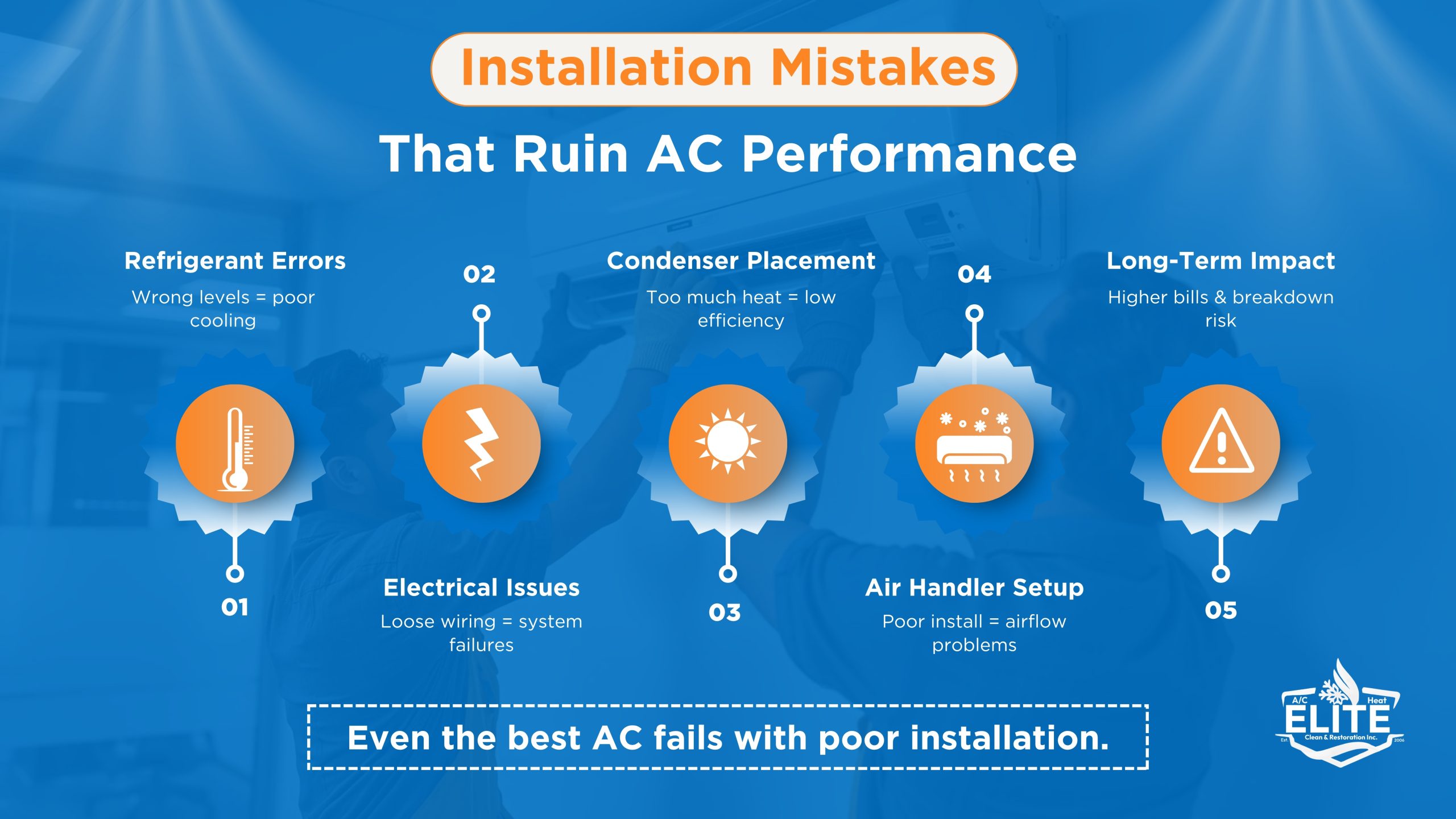
Refrigerant charge errors
An imprecise refrigerant charge, whether over- or under-filled, directly degrades heat-transfer efficiency. An overcharged system strains the compressor. An undercharged system delivers barely cool air and may develop ice buildup on the evaporator coil, paradoxically blocking airflow and making cooling worse. Correct charging of R-410A or the newer R-454B refrigerants requires precise measurement with calibrated gauges, not estimation.
Electrical connection issues
Loose terminals, incorrect wire gauges, or missing grounding create instability that shows up as erratic cycling, nuisance tripping at the breaker panel, or sudden shutdowns during peak load. Beyond performance, faulty wiring in any HVAC system is a genuine safety hazard.
Outdoor condenser placement
This matters enormously in Dallas. A condenser installed on a south- or west-facing wall, surrounded by heat-reflective hardscape, or squeezed against a fence without clearance, operates at a serious disadvantage. It pulls in superheated ambient air and must work significantly harder to reject heat from the refrigerant cycle.
The ideal setup positions the condenser in a shaded or north-facing location with a minimum of 24-36 inches of unobstructed clearance on all sides. Nearby landscaping should allow airflow rather than trap heat.
Indoor air handler placement
Incorrect pitch on the evaporator coil drain pan, poor accessibility for filter replacement, or installation in an unconditioned attic space without adequate insulation all create performance and maintenance problems that stack up quickly once Dallas summer heat arrives.
Ductwork Failures That Silently Drain Cooling Capacity
Your duct system is the circulatory network of the entire cooling installation. Cooled air produced by the air handler means nothing if it escapes into an attic, crawlspace, or unconditioned wall cavity before reaching your living space. Yet ductwork is frequently the most neglected element of any residential HVAC project.
Why attic ducts are especially vulnerable in North Texas
Attic temperatures in the Dallas-Fort Worth area routinely exceed 140°F in midsummer, a temperature differential of 60°F or more between the conditioned air inside the ducts and the superheated space surrounding them. Even minor gaps at connections, unsealed takeoff collars, or compromised duct insulation translate directly into measurable cooling losses.
The real cost of duct leaks
Industry studies consistently show that leaky or poorly insulated ductwork can reduce delivered cooling capacity by 20 to 30 percent. In practical terms, a homeowner paying for a three-ton system may only receive two tons of cooling in the living space, a deficit no thermostat adjustment can compensate for.
A Manual D duct design and post-installation duct leakage test (measured with a duct blaster) should be standard practice for any quality installation. If your installer didn’t perform either, that’s a red flag.
Signs of ductwork problems after a new installation
- Dramatic temperature differences between rooms (more than 3-4°F)
- High energy consumption despite moderate outdoor temperatures
- Rooms that stay warm no matter how long the system runs
- Weak airflow from certain registers
Thermostat Placement and Configuration Errors
A thermostat installed in the wrong location introduces systematic error into how the entire system operates. The thermostat reads the temperature of its immediate surroundings, not the average temperature of your home.
Locations that cause false readings
When placed near a sun-drenched window, above a kitchen appliance, or next to a lamp running for hours, the thermostat perceives artificial warmth and demands more cooling than the space actually needs, wasting energy. Conversely, a thermostat mounted directly beneath a supply register may read artificially cool temperatures, allowing the rest of the home to drift well above the setpoint.
Where the thermostat should be
During any professional setup, the thermostat should sit on an interior wall in a frequently occupied room, away from heat sources, direct sunlight, drafts, supply registers, and exterior walls. A hallway near the center of the home is often ideal.
Why upgrading to a smart thermostat pays off in Dallas
Adding a Wi-Fi-enabled smart thermostat during installation provides adaptive scheduling, remote monitoring, and real-time performance diagnostics. For homeowners navigating cooling seasons that run six to seven months, the energy savings and early-warning alerts provide a measurable return on investment.
Refrigerant Leaks: A Post-Installation Problem That Compounds Quickly
A properly executed installation should deliver a factory-specified refrigerant charge that remains stable for the life of the equipment. However, microscopic leaks at flare fittings, brazed joints, or service valves can allow refrigerant to escape gradually, sometimes over weeks or months after the initial setup.
How refrigerant loss affects performance
As refrigerant levels drop, cooling capacity deteriorates proportionally. The system runs longer cycles to achieve the same result. Electricity consumption climbs. The evaporator coil may develop ice as falling suction pressure drops below the dew point of indoor air.
Left unchecked, a refrigerant leak will eventually cause compressor failure, one of the most expensive repairs in any HVAC system, often costing $1,500-$3,000 or more for parts and labor.
What the law requires
Refrigerant handling is legally restricted to EPA Section 608-certified technicians. Any service that involves adding, recovering, or repairing refrigerant must be performed by a licensed professional using calibrated charging equipment. If your installer “topped off” the charge without measuring subcooling and superheat values, the charge may not be accurate.
Home Envelope Deficiencies That Overwhelm Even Proper Installations
A correctly sized, expertly installed system can still struggle to maintain comfort in a home with significant air infiltration or inadequate insulation. In Dallas, where cooling loads are driven by both extreme outdoor temperatures and intense solar radiation, the building envelope plays a critical supporting role.
Common air leak locations
Hot outdoor air continuously infiltrates through gaps around door frames, window rough openings, attic hatches, recessed lighting cans, plumbing and electrical penetrations, and unsealed wall cavities. Every cubic foot of infiltration adds to the cooling load the system must overcome.
A blower door test can quantify total air leakage and identify the worst offenders. Many Dallas-area energy auditors offer this service, and it’s an excellent diagnostic step if your new system seems to be struggling.
Attic insulation matters more than most homeowners realize
Attic insulation directly above the living space is especially consequential in Texas. A home with R-19 insulation in a climate that warrants R-38 or higher forces the cooling system to overcome radiant heat transfer that proper insulation would have blocked.
No residential installation, regardless of how well executed, fully compensates for a poorly insulated building envelope.
Maintenance Neglect That Starts Before the First Summer
New cooling systems require active maintenance from the first month of operation. A common misconception is that a brand-new unit can run an entire season without attention. In Dallas, that assumption gets expensive fast.
Air filter replacement
Filters in a newly installed system should be inspected monthly during the cooling season. Airborne dust, construction debris from recent renovations, and pet dander accumulate rapidly in homes running 10-14 hours of cooling daily. A clogged filter restricts airflow through the evaporator coil, reduces efficiency, raises operating temperatures across the refrigerant circuit, and can trigger high-pressure safety shutoffs.
For most Dallas homes, a pleated filter replaced every 30-60 days during summer is the practical standard.
Outdoor condenser maintenance
Condenser coils should be cleared of grass clippings, cottonwood fluff, and debris that collects against the coil surface and restricts airflow. A condenser operating with a 20 percent reduction in airflow from coil fouling loses a corresponding share of cooling capacity.
Annual professional tune-ups
Scheduling professional maintenance in early spring before Dallas summer heat arrives ensures the system is calibrated, lubricated, electrically verified, and operating at the efficiency level it was designed to deliver. Most manufacturers require documented annual maintenance to keep the warranty valid.
Warning Signals That Demand Immediate Attention
Certain symptoms following a new installation should prompt an immediate call to a licensed technician rather than a wait-and-see approach. Acting early limits secondary damage and prevents small deficiencies from escalating into system failures costing thousands of dollars.
Call a professional without delay if you notice any of these:
- The system runs continuously without reaching the thermostat setpoint
- Ice forms on the refrigerant lines or evaporator coil
- You hear hissing, grinding, or persistent clicking during operation
- Indoor humidity climbs noticeably even while the system is running
- Energy consumption spikes sharply compared to similar temperature days
- Warm air blows from supply registers during a cooling cycle
- The outdoor unit trips the circuit breaker repeatedly
Each symptom points to a specific, addressable root cause. Catching them early is the difference between a service call and a compressor replacement.
The Standard That Separates Reliable Installations From Costly Ones
Every AC installation in Dallas should begin with detailed load calculations and end with verified performance testing, not a handshake and a thermostat set to 72°F.
What commissioning looks like
A properly commissioned system should reach the design setpoint within 30 minutes of startup under normal conditions and hold it through the hottest hours of a Texas summer without running continuously.
Documentation you should receive
The installation team should provide you with all of the following:
- Manual J load calculation report
- Refrigerant charge verification
- Supply and return air temperature differential
- Total external static pressure measurement across the air handler
- Duct leakage test results
- Equipment model numbers, serial numbers, and warranty registration confirmation
These aren’t optional extras. They’re the measurable proof that the job was done correctly, and they’re the documents you’ll need if a warranty claim ever arises.
Final Word
A new air conditioning installation that fails to cool a Texas home isn’t simply an inconvenience; it’s a signal that something specific went wrong during sizing, setup, or ductwork design. Pinpointing the root cause and correcting it early protects the system’s longevity, controls energy costs, and restores the indoor comfort that a professional installation is built to deliver.
For Dallas homeowners who expect their cooling system to perform through every punishing summer, the team at Elite Clean & Restoration brings the technical precision, local climate expertise, and installation standards that Texas heat demands.


