




 972-475-4949
 Quick answer
Texas dryer vent installation must meet International Residential Code section M1502: rigid metal duct only (no foil flex), four-inch diameter, total run no longer than 35 feet (with deductions for elbows), and termination outside with a backdraft damper. Cheap installs typically skip rigid ductwork, exceed the length limit, hide elbows behind walls, and use flexible foil that clogs with lint within months. The shortcuts cause house fires. The proper install costs more upfront and lasts 15+ years.
Dryer fires are the third-leading cause of residential structure fires in the United States. The U.S. Fire Administration logs about 13,000 dryer fires a year, and almost a third of them trace back to lint buildup from a poorly installed or never-cleaned vent. In DFW specifically, where homes run dryers heavily through humid Texas summers and cold winter cycles, the risk is higher than the national average.
Texas adopted the International Residential Code (IRC) statewide, with most DFW cities, including Dallas, Plano, Frisco, McKinney, Allen, and Arlington, enforcing the 2018 or 2021 edition. Section M1502 specifically covers dryer exhaust systems. A dryer vent cleaning service that doesn’t meet section M1502 is a code violation. It also voids most homeowner’s insurance claims if a dryer fire happens.
This guide walks through what the code actually requires, where the cheap installers skip, and what a code-compliant install looks like when it’s done right. We pull dozens of bad installs out of DFW homes every year. Almost everyone falls into the same patterns.
What the code actually requires
These are the specific rules from IRC M1502 that apply to every residential dryer vent in Texas.
Rigid metal duct, not flexible foil
The duct material must be smooth-walled metal. Galvanized steel or aluminum, 28-gauge minimum. The foil-style flexible “transition duct” that comes free with most dryers is allowed only for the short connection from the dryer to the wall (typically less than 8 feet) and only if it’s the UL 2158A-rated metal foil type, not the white plastic accordion stuff sold at hardware stores in the 1990s.
The reason: smooth-walled metal lets lint pass through. Corrugated foil traps lint at every ridge. Within six months, a foil run can have an inch of lint coating the inside.
Four-inch diameter
Standard residential dryer vents are 4 inches in diameter. Larger commercial dryers go up to 6 inches. The exhaust port on the back of the dryer dictates the size. Reducing the diameter mid-run (going from 4-inch to 3-inch through a tight wall section) is a code violation. So is increasing it without a manufacturer-approved reason.
Total length under 35 feet, with deductions
The maximum equivalent length is 35 feet. That sounds generous until you understand the deductions. Every 90-degree elbow counts as 5 feet of equivalent length. Every 45-degree elbow counts as 2.5 feet. A 45-degree turn at the dryer, a 90 at the wall, and another 90 in the attic eat up 12.5 feet before the duct does any actual carrying.
In a typical DFW two-story home where the laundry room is in the middle of the house and the vent runs through the attic to a side wall, you can easily hit the 35-foot equivalent limit with three or four turns. Many installers ignore this and run 60 feet of duct with five elbows. The dryer can’t push hot, moist air through that. Lint settles. Fires start.
No screws penetrating the duct interior
Joints must be sealed with foil tape or mastic, not screws. Sheet metal screws driven through the duct wall stick into the airflow, snagging lint at every joint. Code-compliant joints use external clamps or aluminum foil tape rated for HVAC use.
Termination outside with a backdraft damper
The duct must end outside the building (not in an attic, crawlspace, or garage). The exterior cap must have a backdraft damper that opens when the dryer runs and closes when it stops. The cap should also have either an animal screen with openings no smaller than 1/4 inch (smaller traps lint) or no screen at all. Standard window-screen mesh is forbidden it clogs in two weeks.
No bird guards, no screens, no lint traps in the duct
Lint traps installed in-line in the duct (some homeowners add these, thinking they’re helping) are explicitly forbidden by code. They restrict airflow, trap lint, and cause exactly the problem they claim to solve.
Specific clearances near combustibles
The exterior termination point must be at least 3 feet from any window, door, or air intake. The duct itself must have specific clearance from any combustible building material.
The 7 corners cheap installs cut
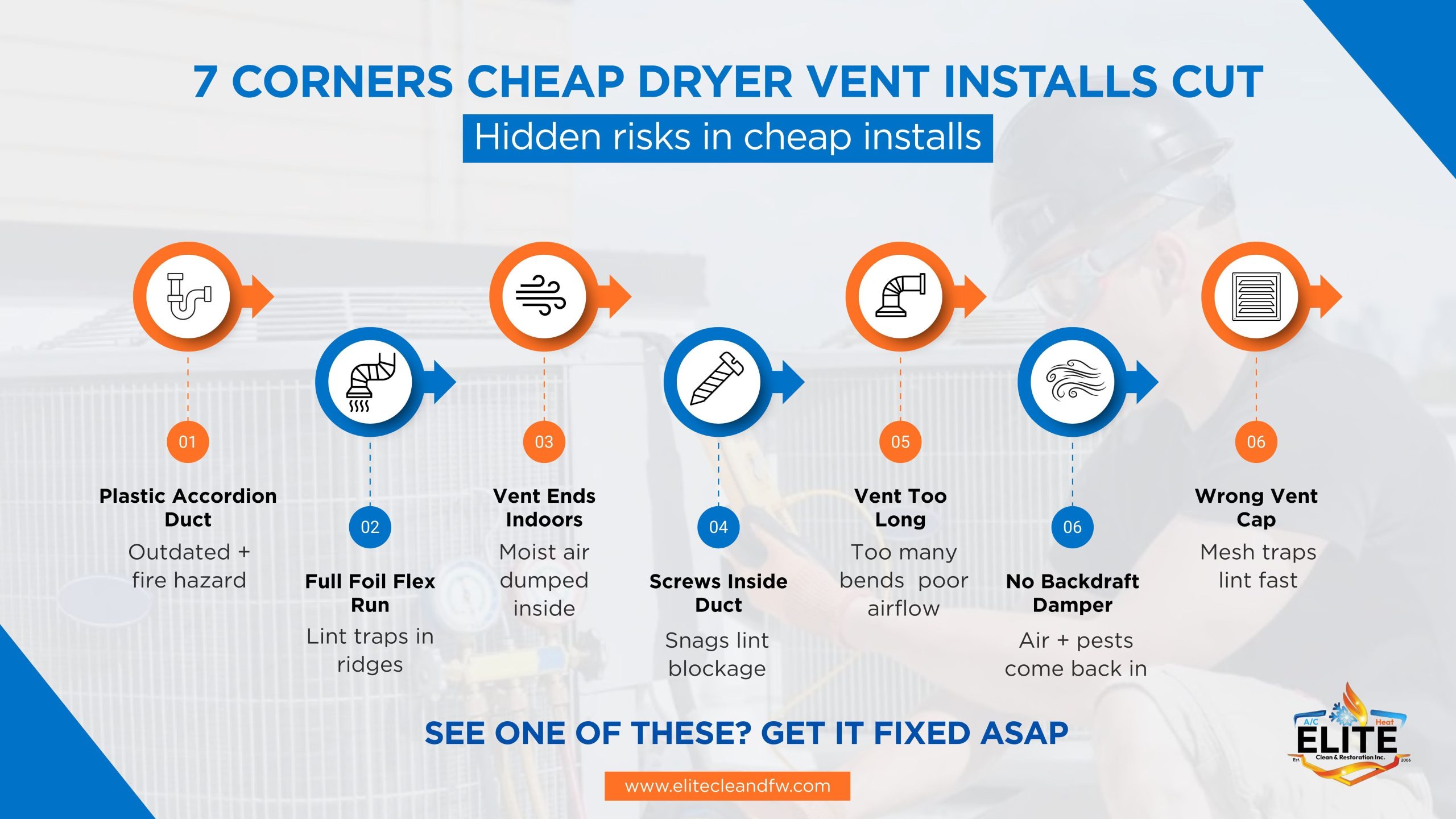
Here’s what we see when we open up a bad DFW install. Pick any one of these, and the install is technically out of code. Most cheap installs have three or four of them.
1. White plastic accordion duct in the wall
The single most common problem. White ribbed plastic flex hose. Available at any hardware store for $8. It’s not just out of code; it’s been off the legal market for over 20 years. If you have it on your wall, replace it. It’s a fire hazard.
2. Foil flex runs through the entire vent path
The metal foil flex duct (silver, accordion-shaped, with a wire spiral inside) is allowed for the short transition only. Cheap installers run it 30 feet through the attic because it bends easily and doesn’t need careful planning. Lint catches at every ridge. Replace with rigid metal.
3. Vent terminating in the attic, garage, or crawl space
Yes, this is real. Some installers terminate the dryer vent in the attic to “save the cost” of going through the roof or wall. The hot, moist air dumps into the attic, soaking insulation, growing mold, and creating a fire risk inside the house. If you ever pull back attic insulation and see a dryer cap pointed at the rafters, you have a problem.
4. Duct with sheet metal screws driven through
You can spot this by feel. Run a hand inside the duct (clean dryer, vent disconnected) if you feel screw points sticking into the airflow; every one of them is grabbing lint. Replace with foil tape joints.
5. Total run length over 35 feet equivalent
Most cheap installs in DFW two-story homes have this. A 50-foot duct with three 90-degree elbows is 65 feet equivalent. The dryer fights against the resistance, runs hotter, and fails sooner.
6. No backdraft damper at the exterior cap
Cheap caps are open or have a flimsy gravity flap that doesn’t close. In Texas wind, this means hot air flows backward when the dryer’s off, allowing pests, debris, and rain into the duct. Install a proper damper.
7. The wrong kind of exterior termination
Round bird guards with fine mesh screens. They look protective. They turn into solid lint plugs in three months. Either use the manufactured backdraft cap with no screen or one with quarter-inch mesh.
What a proper install includes
When we install a dryer vent in a DFW home properly, here’s exactly what’s in the scope.
Materials:
- Rigid 4-inch galvanized steel duct, 28-gauge, factory crimped joints
- HVAC-rated foil tape for sealing joints (not duct tape)
- Manufacturer-approved transition flex (UL 2158A metal foil) at the dryer connection only, max 8 feet
- Backdraft damper exterior cap, paint-matched to the home’s siding or trim
- Strapping every 4 feet of horizontal run to prevent sagging
Process:
- Map the run before any cutting. Calculate equivalent length. If the path needs more than 35 feet equivalent, recommend a booster fan or relocate the laundry vent route.
- Pull permit. Yes, dryer vent installations require a permit in most DFW cities. Cost is $50 to $150.
- Cut clean openings, seal them with proper trim collars.
- Run rigid metal end-to-end. Use long-radius elbows where bends are needed (they have lower equivalent length than tight 90s).
- Seal every joint with foil tape, not screws.
- Terminate outside at the proper height (typically 6 feet above grade, away from windows).
- Install the backdraft damper.
- Test airflow with a manometer or smoke pencil.
- Schedule the city inspection.
Documentation:
- Permit copy
- Manufacturer specifications for the duct material
- Length calculation (how many feet of straight, how many elbows, equivalent total)
- Inspection result
- Warranty terms
A proper install in a DFW two-story home takes 4 to 7 hours, start to finish, for new construction or vent replacement. A retrofit through finished walls can take 8 to 12 hours.
Cost: cheap vs. proper
This is where most homeowners go wrong. The price difference is real but smaller than you think.
| Item | Cheap install | Code-compliant install |
| Duct material | Foil flex, $30 | Rigid metal, $80 to $150 |
| Exterior cap | Plastic, $15 | Backdraft metal cap, $40 to $75 |
| Labor | $250 to $400 | $400 to $750 |
| Permit | Skipped | $50 to $150 |
| Total | $295 to $445 | $570 to $1,125 |
The cheap install runs about half the cost of the code-compliant one. The cheap install also fails within 3 to 7 years, costing you another $295 in replacement, plus higher utility bills (a clogged vent can add $20 to $40 a month in dryer energy) and a real fire risk. Over 10 years, the cheap install costs more in total dollars and brings the risk that the proper install doesn’t.
If a quote for dryer vent installation in DFW comes in under $300 total, ask what’s being skipped. There’s a real chance the answer makes you uncomfortable.
Signs your existing install is bad
If you’ve never inspected your existing vent, do this five-minute check.
- Look at the exterior cap: Run a dryer cycle and watch the flap on the outside cap. If the flap doesn’t open visibly when air is pushing out, the duct is restricted somewhere.
- Feel the dryer wall: Touch the wall behind your dryer mid-cycle. It shouldn’t be more than warm. Hot means the duct is restricted and heat is backing up into the wall cavity.
- Smell the laundry room: A burning smell during a dryer cycle is lint heating up against a restriction. Stop using the dryer until it’s fixed.
- Time a load: A normal load takes 35 to 50 minutes to dry on a regular setting. If your loads run 75 minutes or longer, the vent is restricted.
- Check the lint screen residue: A small amount of lint on the screen after each load is normal. A thick mat after every cycle, or visible lint beyond the screen pulled into the dryer body, means lint isn’t venting out.
Two or more of those? Get the vent inspected. A proper inspection runs about $125 to $200 and includes a borescope camera through the full duct path. If the inspector finds code violations, the repair quote should reference the specific section of M1502.
What it takes to bring a bad install up to code
Depends on what’s wrong. Common scenarios:
- Foil flex throughout, run is of reasonable length: Replace with rigid metal. About $400 to $700 in retrofit.
- Duct terminating in attic: Run new path to exterior, install proper cap. $700 to $1,400.
- Run over 35 feet equivalent: Either reroute (expensive) or install a duct booster fan with a thermal switch. Booster fans run $250 to $500 installed.
- Termination cap with fine mesh: $50 to $125 to swap the cap.
We give written quotes for code retrofits with the specific code section being addressed. That documentation matters at resale and for insurance.
A quick note on insurance
Most homeowner’s policies have a clause that voids fire damage coverage if the cause is non-code-compliant work. A dryer fire traced to a flex duct or a missing backdraft damper can mean tens of thousands in fire damage that your insurance won’t cover.
Some insurance carriers in Texas are now asking for proof of code-compliant dryer vent installation at policy renewal, especially after recent dryer fire claims in the DFW area. If you have to file a claim and they ask for documentation, the permit and inspection record is what proves compliance.
Bringing it together
A properly installed dryer vent always costs a little more upfront, but it pays for itself in lower energy bills, better dryer performance, and most importantly, reduced fire risk over time. The code requirements aren’t arbitrary; they exist because dryer vent fires are both common and preventable.
Materials like rigid metal ducting, correct vent length, fully sealed joints, and a proper backdraft cap all work together to keep the system safe and efficient. A permit simply confirms the installation meets those standards. The shortcuts some installers take to win on price are often the exact issues that lead to failure later.
At Elite Clean & Restoration, we’ve installed and corrected hundreds of dryer vents across the DFW area. If your home was built between 1995 and 2010 and still has original ductwork, there’s a strong chance it no longer meets current code or safety standards. A quick 30-minute inspection can tell you exactly where things stand.


