




 972-475-4949
 Quick Answer
The short version of deep cleaning vs regular cleaning comes down to depth and frequency. A regular cleaning keeps up with everyday mess: floors, counters, bathrooms, dusting the surfaces you see, and emptying the trash. It is the upkeep you book weekly or every other week to stay on top of daily life. A deep clean goes after the buildup that regular visits skip. Think baseboards, inside the oven, behind appliances, grout scrubbing, vent and fan blades, window tracks, and door frames. In a place like Dallas-Fort Worth, where dust and seasonal pollen settle fast, a deep clean every few months keeps that grime from turning into a permanent layer. Most homes start with one deep clean, then switch to lighter regular visits to maintain it. If you are not sure which to book first, start deep, then keep up.
Why Does DFW Dust Make This Choice Different?
DFW homes collect dust faster than a lot of the country, and that changes how you think about cleaning. Wind off open North Texas land carries fine grit, and our long pollen seasons (cedar in winter, oak and grass in spring) push particles into every gap. That fine layer does not just sit on coffee tables. It works into baseboards, settles on top of cabinets, coats ceiling fan blades, and rides air through your vents into corners that a quick wipe never touches.
So the deep cleaning vs regular cleaning question is not just about how messy your house looks. It is about what is building up where you cannot see it. A regular cleaning handles the visible stuff. A deep clean resets the hidden buildup before it gets baked in. For allergy-prone households here, that reset matters more than it would in a low-pollen climate, which is why many local families lean on deep cleans more often than the national average.
There is a second North Texas factor people forget: our heat. From May through September, air conditioners run almost nonstop, which means your home is constantly pulling air through filters and ducts and circulating whatever dust is already inside. A house that sits closed up and recirculating for five straight months traps fine particles in soft surfaces and tight corners. A deep clean at the front of summer, and another as fall arrives, lines up neatly with how DFW homes actually breathe across the year.
What Does a Regular Cleaning Actually Cover?
A regular cleaning is maintenance, and it sticks to the surfaces and tasks that pile up between visits. Here is what a standard recurring visit usually includes:
- Vacuuming carpets and rugs, plus sweeping and mopping hard floors
- Wiping down kitchen counters, the stovetop, and the outside of appliances
- Cleaning and disinfecting bathroom sinks, toilets, tubs, and showers
- Dusting reachable surfaces like tables, shelves, and dressers
- Emptying trash bins and tidying clutter
- Wiping mirrors and glass
The point of recurring house cleaning is consistency. When a crew comes every week or two, the mess never gets a chance to build. The work goes faster, costs less per visit, and your home stays at a steady baseline. What regular cleaning does not do is dig into the spots that only get dirty slowly. That is by design. Trying to scrub grout or pull out the fridge on every visit would make each clean far longer and far more expensive than it needs to be.
Think of a regular clean as the difference between tidy and reset. It keeps the rooms you live in looking and feeling fresh: a kitchen you can cook in, bathrooms that stay sanitary, and floors free of crumbs and pet hair. What it cannot do in a couple of hours is reach the slow-building grime hiding behind and beneath the surfaces you use every day. That is the line where a deep clean takes over.
What Does a Deep Clean Include That a Standard Clean Doesn’t?
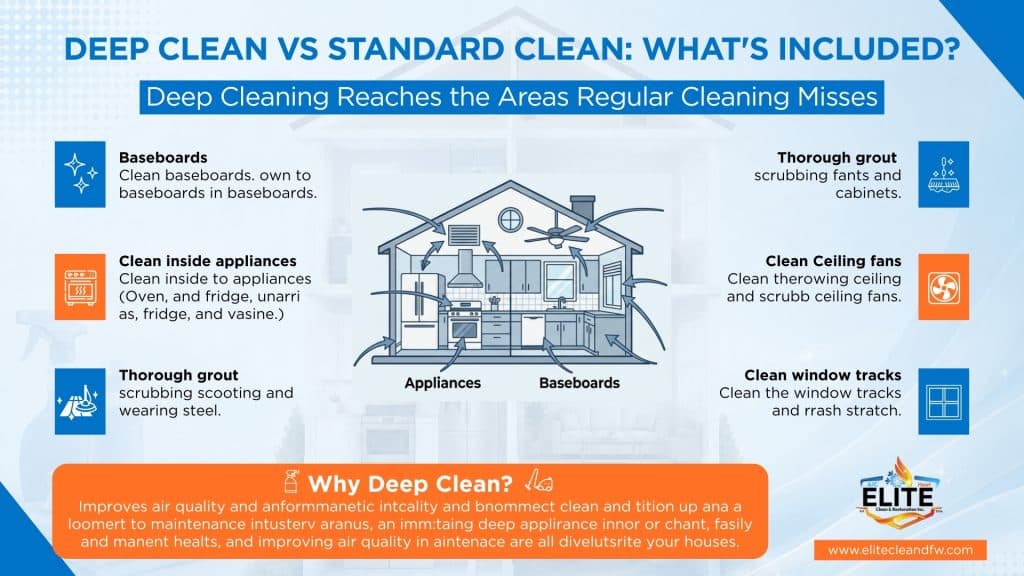
A deep clean covers everything a regular clean does, then adds the detailed, time-heavy work that builds up over months. This is the real answer to deep cleaning vs regular cleaning: the deep version reaches the places routine visits intentionally skip. A typical house deep cleaning DFW crew will tackle:
- Baseboards, door frames, and window sills were wiped or scrubbed by hand
- Inside the oven, microwave, and refrigerator
- Behind and underneath movable appliances
- Grout scrubbing and tile detailing in kitchens and bathrooms
- Ceiling fan blades, light fixtures, and air vent covers
- Cabinet fronts and the tops of cabinets, where dust collects
- Window tracks, blinds, and sills
- Detailed corner and edge work where dust packs in
That vent and fixture work is where DFW homes really benefit. The dust that rides through your air system lands on vent covers and fan blades, and over time it gets thick. Cleaning those surfaces is part of a good, deep clean, and it pairs well with keeping the air system itself clean. If you have noticed visible dust pushing out of your registers, that points to your ductwork too, and our air duct cleaning service addresses the source rather than just the surface.
A deep clean takes longer because it is hands-on, detail work. A crew that breezes through a regular clean in a couple of hours might spend most of a day on a first-time deep clean, depending on the size and condition of the home.
It also tends to catch problems before they grow. When a crew is down on hands and knees scrubbing baseboards or pulling out the refrigerator, that is often when small issues surface: a slow leak under the sink, mildew starting in a grout line, a vent cover packed solid with lint. None of those show up during a quick weekly pass. Finding them during a deep clean means you handle a cheap fix now instead of an expensive repair later, which is one more reason the first deep clean on a home pays for itself in ways the price tag does not show.
How Often Should DFW Homes Get a Deep Clean?
For most DFW homes, a deep clean every three to four months keeps buildup under control, but the right number shifts based on your house and who lives in it. Use these factors to land on a schedule that fits:
If you have pets
Pet hair, dander, and tracked-in dirt build up fast. Homes with dogs or cats often do well with a deep clean every two to three months, since fur works into baseboards, vents, and corners between regular visits. Dander is also a common allergen trigger, so more frequent deep cleaning helps the people in the home breathe easier. Shedding seasons in spring and fall make this worse, so timing a deep clean to the start of each can keep the worst of the hair from settling in.
If anyone has allergies or asthma
DFW pollen seasons are long and intense. If someone in the house reacts to dust or pollen, lean toward the more frequent end, every two to three months, and time a deep clean for the start of spring before oak and grass pollen peak. Knocking down the settled allergen load on vents, fans, and baseboards makes a real difference indoors.
If your home sees heavy dust
Newer neighborhoods near open construction, homes close to highways, and houses with older windows all pull in more grit. If you are dusting visible surfaces more than once a week just to keep up, your hidden buildup is climbing too, and a deep clean every three months is reasonable.
If it is a low-traffic home
A smaller household with no pets and no allergy concerns can often stretch to every four to six months and stay comfortable with regular cleaning in between. Even then, a once-a-year deep reset before the holidays is worth it.
If you have young kids
Households with small children sit somewhere between the pet and allergy categories. Sticky spills, crumbs in places you would not expect, and constant contact with floors and low surfaces all add up. Kids also tend to be more sensitive to dust and allergens, so a deep clean every three months, with extra attention to floors, baseboards, and reachable surfaces, keeps the spaces they crawl and play in genuinely clean.
The pattern most families settle into is one deep clean to set the baseline, recurring house cleaning to hold it, and a deep clean a few times a year to handle what the regular visits cannot reach.
What Does a Deep Clean Cost, and What Drives the Price?
A deep clean costs more than a regular clean because it takes more hours and more detailed labor, and any honest cleaning service cost depends heavily on your specific home. Rather than quote a flat number that may not fit your house, here is what actually moves the price up or down:
- Square footage: More space means more floors, more bathrooms, and more surfaces. This is the single biggest driver.
- Number of bathrooms and bedrooms: Bathrooms are labor-heavy with grout, tile, and fixtures, so a home with three baths costs more than one with one.
- Condition and time since the last deep clean: A home that has not had a deep clean in a year takes longer than one that gets them quarterly.
- Add-ons: Inside-the-fridge, inside-the-oven, interior windows, and pulling out appliances can be included or added depending on the scope you choose.
- Pets: Extra hair and dander add time.
- Frequency: Regular recurring visits cost less per visit than a one-time deep clean, because there is simply less to do each time.
A deep clean commonly runs in a range of roughly double a regular visit for the same home, sometimes more for a first-time clean on a house that has gone a long while. The smart move is to get a quote tied to your actual square footage and bathroom count rather than guessing from a generic figure. Frequency works in your favor: once the baseline is set, recurring cleans stay affordable because the home never falls far behind.
It helps to picture the two side by side. A regular visit to a typical three-bedroom, two-bath home is usually quick because nothing has had time to build. The same home getting its first deep clean in a year is a different job entirely: the crew is scrubbing grout that has darkened, wiping a season of dust off fan blades, and pulling appliances that have not moved in months. That is why the first deep clean carries the highest price of any visit you will book, and why every clean after it costs less. You are paying once to dig out a backlog, then paying to keep it from ever piling up again.
How Do You Decide Which To Book First?
Book the deep clean first, then maintain with regular visits. That order works for almost every home because the deep clean resets your starting point, and the regular cleans hold the line from there. If you jump straight into recurring cleaning without a deep clean first, the crew spends visit after visit slowly chipping at built-up grime instead of maintaining a clean home, which is slower and less satisfying.
Here is a simple way to choose:
- New to a cleaning service, or has it been months? Start with a deep clean. You will see the biggest difference, and it gives every future visit a clean baseline.
- Just moved in or about to move out? Deep clean. Move situations almost always call for the detailed version, including inside cabinets and appliances.
- Already on a regular schedule and keeping up fine? Stick with regular cleaning and add a deep clean seasonally, especially before spring pollen.
- Prepping for guests, a holiday, or an event? A deep clean before the event, then regular visits after.
If your concern is less about surfaces and more about the air, dust, and allergens moving through the house, the cleaning schedule is only half the picture. The other half is your air system. Persistent dust that comes back days after a clean, musty smell, or visible buildup on vents often traces back to the ducts and vents themselves. Our vent cleaning service and dryer vent care handle the parts of your home that a mop and cloth never reach, and they pair naturally with a deep clean for a real top-to-bottom reset.
Ready to reset your home and keep it that way
The clean way to think about deep cleaning vs regular cleaning is simple: deep clean to reset, regular clean to maintain, and lean toward more frequent deep cleans because of our DFW dust and pollen. At Elite Clean & Restoration, we help DFW homeowners pair the right cleaning rhythm with air and vent care so the dust does not just come back next week. Start with a deep clean to set your baseline, then keep it easy with recurring visits. Reach out, and we will tie a quote to your actual home.


