




 972-475-4949
 When your AC quits in a Texas heat wave, the smartest move is simple: call fast, before a small problem turns into an expensive one. There are a couple of things you can glance at first, and we’ll point them out below, but honestly, the quickest path back to a cool house is a call to a team that can actually be there today. That’s us. We run fast service routes across Dallas-Fort Worth with same-day service available for most calls, so you’re hours from help, not days. Don’t sit and sweat it out or risk more damage to your system. Call 972-475-4949, and we’ll take it from here.
It’s 105 Degrees, and the AC Just Quit
There is a specific kind of stress that only hits in a Texas summer: the house is getting warmer by the minute, the thermostat says one thing, and the air says another, and you’re standing in front of a vent cleaning in Dallas that’s blowing nothing but warm air. It’s the middle of a heat wave, everyone you know seems to have the same problem, and you’re wondering how long you’ll have to wait.
First, take a breath. You’re not alone, and you’re in good hands. Some no-cooling calls come down to something simple, and we’ll show you a couple of quick things to glance at. But the rest of this guide is really about something more useful: understanding what’s probably going on, so you know why acting fast matters and what to expect when you call. You don’t have to solve this yourself. That’s our job, and we’re good at it.
So here’s what we’ll cover: what tends to go wrong when the heat spikes, why waiting costs you, how we get you cool again fast, and how to think about repair versus replace if it comes to that. All of it in plain language, no jargon, no pressure.
And if you’re already typing “emergency AC repair near me” or “same-day AC repair in Rowlett, Rockwall, Garland, Plano, or Dallas” into your phone while you read this, you’re in the right place. Elite Clean & Restoration runs fast service routes across the Dallas-Fort Worth metroplex, and we’ll get to the bottom of it. Keep reading, or just call 972-475-4949.
You Don’t Have to Figure This Out Yourself
Here’s the good news before we go any further: you don’t have to diagnose what’s wrong. That’s exactly what we’re here for, and it’s what our EPA-certified techs do every single day of a DFW summer. The rest of this guide will help you feel informed and confident, but you don’t need to become an HVAC installation in Dallas expert on the hottest afternoon of the year. If your air conditioner has quit and your home is heating up, the single best move is to pick up the phone and let us handle it. We’ll pinpoint the problem fast and get you comfortable again, often the same day.
Consider everything below a friendly walkthrough so you know what’s happening and what to expect, not a to-do list you have to work through alone. When you’re ready, we’re one call away at 972-475-4949.
Why a Texas Summer Is So Hard on Your AC
It helps to understand why so many systems fail in July and August specifically. Your air conditioner doesn’t create cold air out of nothing. It moves heat from inside your home and rejects it into the outdoor air. When that outdoor air is already 100 degrees or hotter, the system has to work dramatically harder to shed that heat, and every part inside it runs closer to its limit.
On a typical DFW summer day, an AC that might cycle on and off in milder weather instead runs almost continuously, sometimes 12 to 16 hours straight. That constant run time is exactly when weak parts give out. A capacitor that was marginal in May fails under the sustained load. Refrigerant pressures climb. Motors and compressors run hot. A system that seemed perfectly fine in spring can quit on the first genuinely brutal afternoon, not because anything sudden happened, but because the heat finally found the weakest link.
Texas humidity adds another layer. Your AC isn’t only cooling the air; it’s pulling moisture out of it, and that dehumidification is hard work. A system that’s undersized, low on refrigerant, or fighting a hot attic and leaky ducts has to run even longer to keep up, which pushes it closer to failure and drives your energy bill up at the same time.
None of this means your system is doomed. It means summer is when small, fixable problems reveal themselves, and it’s why catching them early matters so much. The people who sail through August are usually the ones who acted at the first hint of trouble instead of waiting for a full breakdown. If your AC is acting up, that’s your cue to call.
What’s Actually Happening Inside Your AC When It Quits
If you’re curious what’s going on behind that warm air, here’s the short version, and it helps explain why a fast call matters so much. Your air conditioner works by moving heat, not by making cold. A refrigerant circulates through the system, absorbing heat from the air inside your home at the indoor coil, then carrying it outside where the outdoor unit releases it. A compressor drives that whole cycle, a fan pulls air across the coils, and a small electrical part called a capacitor gives the motors the jolt they need to start.
On a mild day, that cycle is easy. On a 105-degree afternoon, it’s a grind. The system has to dump heat into air that’s already blazing, so it runs longer, the pressures climb, and every part works near its limit for hours at a time. When one link in that chain gives out, whether it’s a capacitor, the compressor, or the refrigerant charge, the whole cycle stops, and the air from your vents goes warm almost immediately.
That’s why a system rarely just dies out of nowhere in the summer. Usually one small part reaches its breaking point under the heat, and once it does, the rest of the system can’t do its job. The good news is that catching it at the small-part stage is fast and affordable. The catch is that a struggling system left running can drag other parts down with it, which is the whole reason we tell you to call at the first sign of trouble rather than waiting to see if it sorts itself out. It won’t.
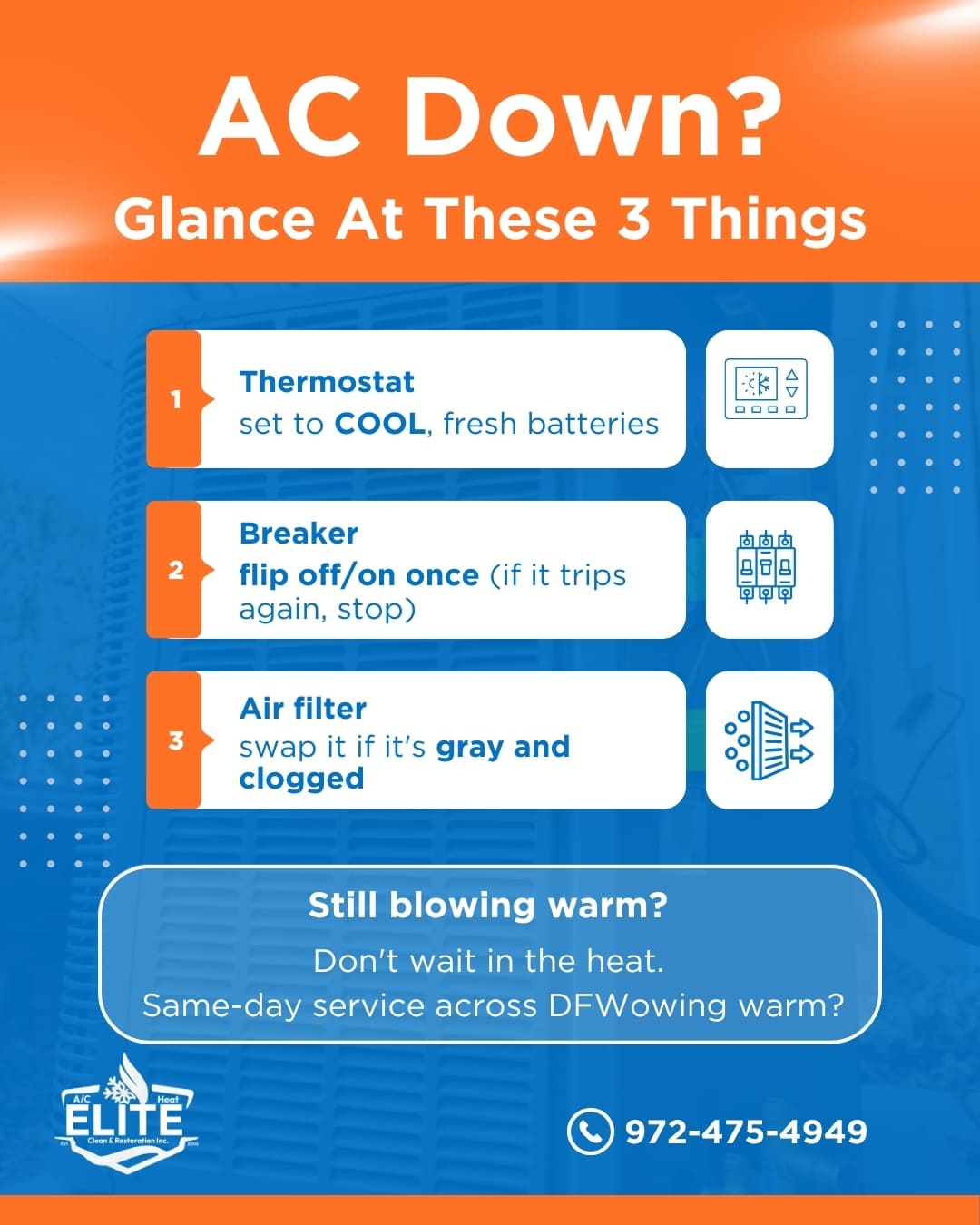
A Few Quick Things You Can Glance At
If you want to take a quick look while you decide to call, there are a few simple things that occasionally turn out to be the whole problem. None of them need tools or any real know-how, and if one does the trick, wonderful. If not, no worries at all. That’s exactly what we’re here for.
Glance at the thermostat: Make sure it’s set to cool, and the temperature is below the current room temp. If it runs on batteries and the screen is blank, fresh batteries sometimes bring it right back.
Check your breaker: If the breaker for your AC has tripped, flip it fully off and back on once. If it trips again, leave it alone and give us a call. That’s a sign of something we should look at.
Look at your air filter: If it’s gray and caked with dust, a fresh one can restore airflow. It’s the one thing worth keeping a spare of in a Texas summer.
And that’s it. We’re not going to send you crawling through a 130-degree attic or poking around the outdoor unit in the heat. If those glances don’t bring the cold air back, the smartest and safest thing to do is call us. We’ll find the real problem fast and get you cool again, often the same day.
Common Reasons an AC Quits in the Heat
When those glances don’t solve it, the cause is almost always one of a handful of common failures. You don’t have to figure out which one; that’s what our techs are for, but here’s a plain-language look at what’s likely going on, so the fix makes sense when we explain it. Notice how many of these get worse the longer a struggling system runs in the heat. That’s the whole case for calling fast.
A failed capacitor: This is one of the most common summer failures. The capacitor gives your motors the jolt they need to start. When it weakens or fails in the heat, the compressor or fan won’t spin up, and you get warm air or no air at all. It’s usually an affordable, fast fix when caught early.
A bad contactor: The contactor is the switch that tells your outdoor unit to run. Pitted or stuck contacts are a frequent cause of a system that won’t kick on, or won’t shut off, on a hot day.
Low refrigerant from a leak: If your system is low on refrigerant, it can’t absorb heat properly, so it runs constantly and still blows warm. Refrigerants don’t get used up over time, so low levels always mean a leak that needs to be found and sealed, not simply topped off.
A frozen evaporator coil: Restricted airflow from a dirty filter, or low refrigerant, can cause the indoor coil to freeze into a block of ice. Ironically, a frozen AC blows warm air. The fix starts with shutting it off to thaw, then correcting the root cause.
A clogged condensate drain: As your system pulls humidity from the air, that water has to drain away. A clogged line trips a safety float switch that shuts the system down to prevent water damage, which is common in our humid summers.
A dirty outdoor condenser: Caked-on dirt, grass, and cottonwood keep the outdoor unit from rejecting heat, so the system runs hot and struggles to keep up. A clean condenser is one of the simplest ways to keep an AC healthy.
A failing compressor or an aging system: The compressor is the heart of the system. When it goes, especially on an older unit, you’re usually looking at a replacement decision. Systems past 12 to 15 years are the most likely to reach this point during a heat wave.
The reason speed matters is that these problems build on one another. A dirty condenser makes the compressor run hotter. A small refrigerant leak freezes the coil. A weak capacitor strains the motor. Catch it on day one, and it’s often a quick, affordable repair. Wait a week in 105-degree heat and a minor part can take the whole system down with it.
What NOT to Do When Your AC Quits in the Heat
Just as important as the right moves are the wrong ones. These are the mistakes that turn a manageable repair into an expensive one, or an inconvenience into a safety issue.
Don’t keep resetting a breaker that keeps tripping: A breaker trips to protect you. If it won’t stay on, something is drawing too much current, and forcing it can damage the compressor or start a fire. Reset once; if it trips again, leave it off.
Don’t run a frozen system: If you see ice on the refrigerant lines or the indoor coil, turn the system off and let it thaw. Running a frozen AC can burn out the compressor, which is the single most expensive part to replace.
Don’t ignore burning smells or grinding noises: A burning smell, buzzing, or grinding means you shut it down and call now, not tomorrow. Those are warning signs, not quirks.
Don’t pour water on the outdoor unit or add refrigerant yourself: Hosing down a hot unit or buying a DIY refrigerant kit usually does more harm than good. Low refrigerant means there’s a leak, and topping it off without fixing the leak just wastes money and can damage the system.
Don’t wait it out if someone is vulnerable: For homes with infants, older adults, or anyone with a health condition, a failed AC in 105-degree heat is a real safety concern. Don’t tough it out. That’s exactly what same-day and emergency service is for.
Why Is My AC Running but Blowing Warm Air?
If your AC is running but the air coming out is warm, the most common causes are a tripped outdoor breaker, a badly clogged filter, low refrigerant from a leak, a frozen coil, or a failing capacitor or compressor. Start with the easy ones. Confirm the thermostat is set to cool, check that the outdoor unit’s breaker hasn’t tripped, and replace a dirty filter. If the indoor fan is blowing but the outdoor unit isn’t running, that usually points to an electrical part like a capacitor or contactor. If you see ice on the refrigerant lines, the system is frozen and needs to be turned off to thaw before it will cool again.
Warm air from a running system is one of the most common summer calls we get across Dallas-Fort Worth, and it’s usually fixable. The catch is that the longer a system runs warm in the heat, the harder it works and the more likely a small problem becomes a big one. If the quick checks don’t bring the cold air back, turn the system off to avoid further damage and call for same-day service.
How Do I Reset My AC After a Breaker Trip or Power Outage?
After a power outage or a tripped breaker, a simple reset sometimes brings your system back: turn the thermostat off, flip the tripped breaker fully off and back on once, then set the thermostat to cool and give it a few minutes, since many systems have a built-in delay before the compressor restarts. Here’s the important part, though. If the breaker trips again, or the system still won’t cool, don’t keep flipping switches. A breaker that won’t hold points to an electrical problem, and repeatedly resetting it can damage the system or create a safety risk. That’s the moment to call us and let a technician handle it safely, which is usually the faster route to cold air anyway.
How to Stay Comfortable Until We Get There
Even with same-day service, there may be a few hours between your call and a cool house. Here’s how to keep your home and your family as comfortable and safe as possible in the meantime, especially during a serious heat wave.
Close blinds and curtains on the sunny side: South- and west-facing windows let in a surprising amount of heat in the afternoon. Blocking that direct Texas sun makes a real difference quickly.
Run your ceiling and box fans: Fans don’t lower the temperature, but moving air helps your body cool itself and can make a warm room feel several degrees more comfortable.
Avoid adding heat: Skip the oven, the stovetop, and the dryer until your AC is back. Every one of those pumps heat into the house. It’s a good afternoon for cold meals or takeout.
Hydrate and head to the lowest floor: Heat rises, so the lowest level of your home stays coolest. Drink plenty of water and take it easy until the air is back on.
Check on the people who need it most: Infants, older adults, pets, and anyone with a health condition are the most vulnerable when the AC is down in extreme heat. If your home is climbing past a safe temperature, don’t tough it out. Tell us when you call so we can prioritize and move somewhere cooler if you need to.
These are stopgaps, not solutions, but they buy you more comfortable time while help is on the way.
When to Just Call Us (Which Is Most of the Time)
Honestly, you don’t have to be sure anything is seriously wrong to call. If your home isn’t cooling and a glance at the thermostat, breaker, and filter didn’t fix it, that’s reason enough. Definitely call right away if you notice warm air from the vents, weak or no airflow, the system short-cycling on and off, ice on the lines, water pooling by the indoor unit, unusual noises or smells, or a breaker that won’t stay set. Those all point to problems that need tools, training, and refrigerant-handling certification to fix safely. When in doubt, call. We would always rather take a quick look than have you wait while a small problem grows.
Here’s why speed matters in a Texas heat wave. A struggling AC doesn’t fail politely. A small refrigerant leak becomes a frozen coil. A weak capacitor becomes a burned-out compressor. A minor drainage clog becomes water damage. Every hour a compromised system runs in extreme heat, it works harder and edges closer to a failure that costs far more than the original problem. Catching it early is almost always the cheaper path, and in peak summer, early means today.
The Real Cost of Waiting in a DFW Heat Wave
It’s tempting to wait a day and hope the system recovers, especially when you know every AC company in town is slammed. Here’s why that gamble usually backfires. Picture a small refrigerant leak on a Monday. The system is low, so it runs constantly and still can’t keep up. By Tuesday, the low pressure has let the indoor coil freeze into a block of ice, so now you’re getting no cooling at all. By Wednesday, that melting ice has overflowed the drain pan and left a stain on your ceiling, and the compressor, which has been straining the whole time, is running dangerously hot.
What started as an affordable refrigerant repair on Monday has become a frozen system, water damage, and a compressor on the edge of failure by midweek. The compressor is the most expensive part in the entire system, and once it goes, you’re usually looking at replacement rather than repair. The same story plays out with a weak capacitor that strains a motor, or a dirty condenser that overheats the compressor. Small problems don’t stay small in this heat.
Calling early almost always means the opposite: a quick diagnosis, a smaller repair, a shorter wait, and a house that’s comfortable again the same day. There’s no penalty for calling at the first sign of trouble, and a real, growing cost to waiting. When your AC starts acting up, the cheapest day to fix it is today.
Signs Your AC Is About to Fail (Catch It Before the Next Heat Wave)
The best emergency AC call is the one you never have to make. Most systems give warning signs before they quit completely, and noticing them early turns a stressful breakdown into a scheduled, affordable repair. Watch and listen for these:
Weak airflow or warm rooms. If some rooms never get comfortable, or the air from your vents feels weaker than it used to, your system is struggling to keep up.
Longer and longer run times. An AC that runs almost constantly and still can’t reach the thermostat setting is telling you something is wrong, whether it’s the unit, the ducts, or the insulation.
Short-cycling. If your system clicks on and off every few minutes, that rapid cycling wears out parts fast and points to a problem worth checking now.
A bill that jumped with no change in habits. A summer bill well beyond last year, with the same thermostat settings, usually means your system is losing efficiency.
New sounds or smells. Buzzing, clicking, rattling, or musty and burning odors are all early warnings. They rarely fix themselves.
If any of these sound familiar, a tune-up now is far cheaper and less stressful than an emergency call in the middle of August. We would much rather catch a tired capacitor on a scheduled visit than replace a compressor during a heat wave.
Repair or Replace? We’ll Give It to You Straight
When a technician tells you the fix is significant, the repair-or-replace question lands on you at the worst possible time, in the heat, under pressure. Here’s a calm way to think about it. Consider replacement seriously if your system is more than 12 to 15 years old, uses the older R-22 refrigerant that’s no longer produced, has needed multiple repairs in recent summers, or the repair estimate approaches a large fraction of a new system’s cost. In those cases, pouring money into an aging unit often just delays the inevitable, and usually the next failure hits on an even hotter day.
If your system is newer, has been reliable, and the repair is a defined part like a capacitor, contactor, or motor, repair is very likely the right call. Our job is to give you the honest measurements behind the recommendation, not a scare tactic. We carry a written diagnostic checklist on every truck. If a capacitor and a refrigerant fix solve it, that’s what we do. If your system has genuinely reached the end of its life, we show you why, with the actual numbers, so the decision is yours and it’s informed.
A couple of specifics are worth knowing. If your system uses R-22 refrigerant, which has been phased out and is no longer produced, any repair involving refrigerant gets expensive fast, and that often tips the math toward replacement. Newer systems use R-410A or the latest low-emission refrigerants and are far more efficient. That efficiency is measured in SEER2, and moving from an old builder-grade unit to a modern high-SEER2 Lennox system can meaningfully lower your summer bills, sometimes enough to offset a real portion of the monthly payment. Sizing matters more than most people realize, too: a system that’s too large cools in brief bursts without removing humidity, leaving your home cold and clammy, while one that’s too small never catches up. When we quote a replacement, we size it to your actual home, not a rule of thumb.
And know this: the decision is always yours, and we won’t rush you into it. If AC replacement in Dallas is the right move, we’ll show you exactly why, lay out your options and the financing, and give you room to choose. If a repair buys you another few good years, we’ll tell you that too, even though a repair is the smaller ticket for us. Our goal isn’t to sell you the most expensive option. It’s to give you the honest information you need to make the call that’s right for your home and your budget, and then to stand behind whatever you decide.
Financing in a Pinch: You Don’t Have to Wait in the Heat
A full system replacement is a real expense, and it never picks a convenient moment. That’s exactly why we offer financing through reputable lenders, with plans that fit most budgets and, for many customers across DFW, low or introductory-rate options. As a Lennox Preferred Dealer, we can get you into a properly sized, high-efficiency system quickly, so a failure during a heat wave doesn’t mean days of suffering while you save up. You get cool air now and a payment plan that works, rather than a stark choice between a big lump sum and a miserable week.
Ask us about financing when we give you the estimate. We’ll walk you through the monthly numbers in plain language before you decide anything.
What to Expect When We Arrive
If you’ve never worked with us, here’s exactly how a same-day call goes, because the experience should be as reassuring as the result. When you call, we get you on the schedule and give you a realistic arrival window instead of a vague all-day wait. Our EPA-certified technician arrives in a clearly marked vehicle, ready to work.
From there, we diagnose before we quote. We carry a written diagnostic checklist on every truck, and we work through it to find the actual cause, not a guess. Then we explain what we found in plain language, show you the measurements behind it, and give you upfront pricing before any work begins. If it’s a straightforward repair, we usually handle it on the spot. If it’s a bigger decision, you get honest options and the real tradeoffs, with no pressure and no scare tactics.
What we won’t do is the thing that has unfortunately become common at some larger chains: find one small problem and push you toward a full system replacement you don’t need. If a capacitor and a refrigerant fix solves it, that’s what we install. If your system has genuinely reached the end of its life, we explain why with the actual numbers. And we don’t pack up the truck until you’re genuinely satisfied with the work, because every job is backed by our 100% Satisfaction Guarantee.
We also try to leave you better informed than we found you. Our technicians will happily show you what went wrong, explain what to watch for, and share the simple habits that keep your system healthy, because a customer who understands their system is a customer who trusts us. Plenty of the reviews we’re proudest of mention exactly that: someone who expected a sales pitch and left having actually learned something about their own home.
What Same-Day Service Really Means (and How to Get Seen Fastest)
Same-day service means what it says: for most calls placed before noon, we aim to have a technician at your home the same day, and emergency dispatch covers evenings and weekends for true no-cooling situations. During a metro-wide heat wave, demand spikes for every HVAC company in DFW, which is exactly why running efficient service routes from our central Rowlett location matters. It’s how we keep response times short when everyone needs help at once.
There are a few things you can do to get seen faster and make the visit go smoothly. Call early in the day rather than waiting to see if the system recovers. Have your details ready: the system’s approximate age, the symptoms you’re seeing, and anything you already checked. Make sure the technician can reach both the indoor and outdoor units, so clear any storage around the furnace or air handler and trim back growth near the outdoor condenser. And if anyone in the home is medically vulnerable to the heat, say so when you call, because that moves you up the priority list.
The truth about heat waves is that the earlier you call, the faster you’re helped and the smaller the repair tends to be. Waiting a day to see if it fixes itself usually means a hotter house, a longer line, and a bigger problem.

What a Fast Repair Actually Looks Like
Speed only matters if the work is done right. Here’s the kind of turnaround our DFW neighbors describe again and again: a call that gets answered, a technician who arrives quickly, diagnoses honestly, explains the problem in plain terms, and gets the home cool again, often within the same day for a repair, and within a couple of days even for a full system replacement. No pressure, no mystery, no upsell. Just a clear diagnosis and a home that’s comfortable again.
A Local Team That Actually Answers the Phone
There’s a reason so many people across DFW keep our number saved. When your AC quits in the heat, you don’t want a call center three states away or a week-long wait for the next available slot. You want a local team that answers, understands exactly how brutal a North Texas August is, and can actually get to you today.
We’ve been doing this from our Rowlett home base since 2006, which means we know these neighborhoods, these homes, and the way these summers punish a cooling system. Our trucks run fast routes across the metroplex, our technicians are EPA-certified and trained across every major brand, and the person who shows up treats your home the way they’d want their own treatment. That combination of local roots, real expertise, and a genuine commitment to doing right by you is what nearly two decades and more than 1,250 five-star reviews are built on.
When you call us, you’re not a ticket in a queue. You’re a neighbor who needs help, and we treat it that way.
What Our Customers Are Saying
“Very pleased with the service from Elite! We had an issue where our A/C wasn’t running. Called on a Friday and the technician came the next day and right away was able to determine the fan motor in our furnace had died on our 20-year-old setup. Was able to schedule a new furnace and A/C for Monday. The crew came by around 8:45 AM and was done by around 1:15. Quick and efficient, and all of the guys were very friendly. I highly recommend this company!”
Jacob, Verified Google Review ⭐⭐⭐⭐⭐
What Temperature Should I Set My Thermostat in a Texas Summer?
For a Texas summer, 78 degrees when you’re home is the widely recommended setting for a good balance of comfort and cost, with a few degrees warmer, around 82 to 85, while you’re away or asleep. Every degree below 78 can add roughly 6 to 8 percent to your cooling costs, so setting the thermostat to 68 on a 105-degree afternoon mostly runs up the bill without cooling the house any faster.
A better move is to pair 78 with ceiling fans, which make a room feel several degrees cooler by moving air across your skin, and to close the blinds on the sunny side of the house in the afternoon. A programmable or smart thermostat makes this easy, nudging the temperature up while you’re out and cooling the house back down before you get home. One important caution for the deep Texas heat: setting the thermostat far below the outdoor conditions won’t make the air any colder. Your AC can only cool the air so many degrees below the outdoor temperature, so on the worst afternoons, a realistic setting keeps the system from running itself ragged chasing a number it physically can’t reach.
Comfort Is About More Than a Number on the Thermostat
When your AC comes back to life, real comfort is about more than the temperature reading. In a humid Texas summer, how a home feels depends just as much on the moisture in the air and how evenly that cool air reaches every room. A system that’s the right size and in good health doesn’t just cool; it pulls humidity out of the air so 78 degrees actually feels like 78, instead of a clammy 78 that has you reaching for the thermostat.
That’s part of why an oversized or struggling system can leave a home feeling muggy even while the thermostat says it’s cool. It blasts cold air in quick bursts and shuts off before it ever wrings the moisture out. It’s also why some rooms stay warm while others are freezing, usually a sign of duct cleaning in Dallas or airflow problems rather than the AC itself. When we diagnose a comfort complaint, we look at the whole picture: the unit, the ductwork, the airflow, and the humidity, so the fix actually solves the problem you’re feeling rather than only the number on the wall.
Getting all of that working together is what turns a house that’s technically cool into a genuinely comfortable home, and it’s the standard we hold every job to.
Preventing the Next Breakdown: Maintenance That Actually Helps
Once your home is cool again, a little routine care dramatically lowers the odds of another emergency and keeps your bills in check through the worst of the Texas heat. Here’s what actually moves the needle.
Twice-a-year tune-ups. A spring cooling tune-up and a fall heating tune-up catch weak parts before they fail and keep your system running at its rated efficiency. Most heat-wave breakdowns we see were preventable with a seasonal check.
Change your filter on schedule. A clean filter is the single easiest thing you can do. Check it monthly in summer and replace it when it’s dirty. A clogged filter strains the whole system and can freeze the coil.
Keep the outdoor unit clear. Give the condenser two feet of clearance and rinse off caked dust and pollen. It’s a five-minute job that helps your system reject heat the way it’s designed to.
Address the hidden efficiency drains. In a DFW summer, a 130-to-150-degree attic and leaky ductwork force your AC to run far harder than it should. Upgrading attic insulation and adding solar attic ventilation in Dallas can drop attic temperatures 30 to 40 degrees, which means your system runs less, lasts longer, and costs less to operate. It’s one of the highest-return upgrades in a Texas home.
Ask us about a maintenance plan. Members get priority scheduling when the heat hits, which is exactly when you want to be at the front of the line.
What Sets Us Apart From the Big HVAC Chains
If you’ve ever had a big HVAC chain out to your place, you might know the routine: a technician finds one small problem, and somehow the conversation turns into a pressured pitch for a whole new system you never planned to buy. We built Elite Clean & Restoration to be the opposite of that.
We carry a written diagnostic checklist on every truck, and we diagnose before we quote. If a capacitor and a refrigerant fix solve your problem, that’s what we do. If your system has genuinely reached the end of its life, we show you the actual measurements behind that recommendation and lay out your options, including financing, without any pressure. You get straight answers, upfront pricing, and a team that treats your space and your budget with respect. It’s how a family-owned company earns more than 1,250 five-star reviews and keeps neighbors calling back for nearly two decades.
Why DFW Trusts Elite Clean & Restoration
- Family-owned and operated, serving DFW since 2006
- 1,250+ five-star Google reviews with a 4.7 average rating
- EPA-certified, fully licensed technicians (Texas TACLB #TACLB023175E)
- Same-day service available for most calls placed before noon, with emergency dispatch evenings and weekends
- Lennox Preferred Dealer with factory training, plus financing for repairs and replacements
- 100% Satisfaction Guarantee on every job, backed by a written diagnostic checklist on every truck
- Veteran’s Discount available year-round
- Serving Dallas, Fort Worth, Plano, Frisco, Garland, Mesquite, Richardson, Sachse, Rockwall, Sunnyvale, Grand Prairie, and surrounding communities
Emergency AC Repair Across the DFW Metroplex
Our Rowlett headquarters sits at the center of the eastern DFW metroplex, which lets us run fast service routes and reach most homes quickly, exactly what you need when the AC quits in the heat. We provide same-day and emergency HVAC service across the region:
- East DFW: Rowlett, Rockwall, Garland, Mesquite, Sachse, Sunnyvale, and Rose Hill
- Dallas and central: Dallas, Richardson, Pleasant Grove, and the surrounding neighborhoods
- North: Plano, Frisco, and the northern suburbs
- West: Fort Worth, Grand Prairie, and the western metroplex
Wherever you are in Dallas-Fort Worth, if your AC is down, we’re likely closer than you think. Same-day service is available for most calls placed before noon, with emergency dispatch on evenings and weekends.


