



 972-475-4949
 Furnace cleaning means cleaning the parts inside the furnace cabinet that move air and burn gas: the blower wheel and its housing, the burners, the heat exchanger surfaces, and the drain and vent, if the furnace has them. It is a different job from duct cleaning, which works on the metal and flex runs between the cabinet and your rooms. In a Rowlett, Sachse, or Garland house, the furnace is also the fan your air conditioner uses, so most of what we clean out of it in October went in during July.
TL;DR
Furnace cleaning covers the inside of the furnace cabinet, not the ductwork. Lennox’s homeowner manual for a current gas furnace lists what an annual pre-season visit should check: the burners and heat exchanger for cleanliness, the blower housing, wheel, and motor, the condensate drain and trap on a condensing model, the gas connections for leaks, the vent pipes, and a combustion analysis. Atmos Energy, the gas utility serving Rowlett, tells its customers that routine safety inspection and maintenance of gas appliances is their responsibility and recommends an annual inspection, cleaning, and tune-up of central heating. In North Texas, the dust in a furnace mostly comes from the cooling season, because the same blower runs the air conditioner. Book the visit before heating season, and replace the filter monthly as needed in between.
Is Furnace Cleaning the Same Thing as Duct Cleaning?
No. Furnace cleaning works on the equipment in the cabinet: the fan that pushes air, the burners that make heat, and the heat exchanger that keeps combustion gases separate from the air you breathe. Duct cleaning works on the supply and return runs that carry that air through the attic and into each room. One is a mechanical safety job with cleaning in it. The other is a cleaning job on sheet metal and flex.
The two get blurred because a lot of search results sell them as a bundle, and because both involve a vacuum at some point. They answer different problems.
| Question | Furnace cleaning | Duct cleaning |
|---|---|---|
| What gets worked on | Blower, burners, heat exchanger, drain, vent | Supply and return runs, registers, boots |
| What it protects | Safe combustion, airflow across the heat exchanger, motor life | Air carried to rooms, visible debris at vents |
| How often | Every year before heating season, per the manufacturer | When a specific problem shows up, not on a calendar |
| Who can do part of it | Nobody but a licensed technician, per the manual | Also a contractor job, but no gas work involved |
If the complaint is dust blowing out of the registers, that points toward the ducts, and our Rowlett air duct cleaning page covers what that visit involves. If the complaint is a burning smell on the first cold night, a furnace that lights and then shuts off, or simply that nobody has opened the cabinet in two years, that is the furnace.
The Dust in a Rowlett Furnace Mostly Arrived in July
Here is the part most furnace cleaning pages skip, and it is the reason we wrote this one. They are written for places where the furnace is the machine that works hardest all year. East of Dallas, it is the other way around.
In a typical gas-heated house in Rowlett, Rockwall, or Mesquite, the furnace sits in the attic or a hall closet with the air conditioner’s indoor coil mounted on it. The blower inside the furnace cabinet is the fan for both. When the thermostat calls for cooling in August, that is the furnace blower you hear. Lennox’s own manual assumes this: it tells owners that an indoor blower running at the cooling speed when nothing is calling for cooling can mean a refrigerant leak.
So the heating season is short and the cooling season is long, which is how our own fall heating safety inspection page describes the Rowlett climate too. Every month the air conditioner runs, air crosses the blower wheel, and whatever the filter misses lands on the curved blades. By October, the wheel has had a full summer of that.
What that means in practice:
- A blower wheel coated from the cooling season moves less air, and less air across a heat exchanger makes it run hotter than it was built to.
- The first burn of the year cooks off dust sitting on the burners and heat exchanger. That is the familiar smell on the first cold morning, and it should fade quickly.
- A furnace that sat unused for months has had nothing to test its ignition, flame sensor, or safety switches since spring.
None of that needs a dramatic failure to matter. It is the ordinary wear of a machine that did a second job all summer.
Why the blower wheel gets the most attention in October
The wheel is a drum of shallow curved blades, and dust packs into the curve where a quick wipe cannot reach. It usually has to come out of the cabinet to be cleaned properly. That is also the item most often skipped on a rushed visit, because it takes the most time.
What Gets Cleaned, Item by Item
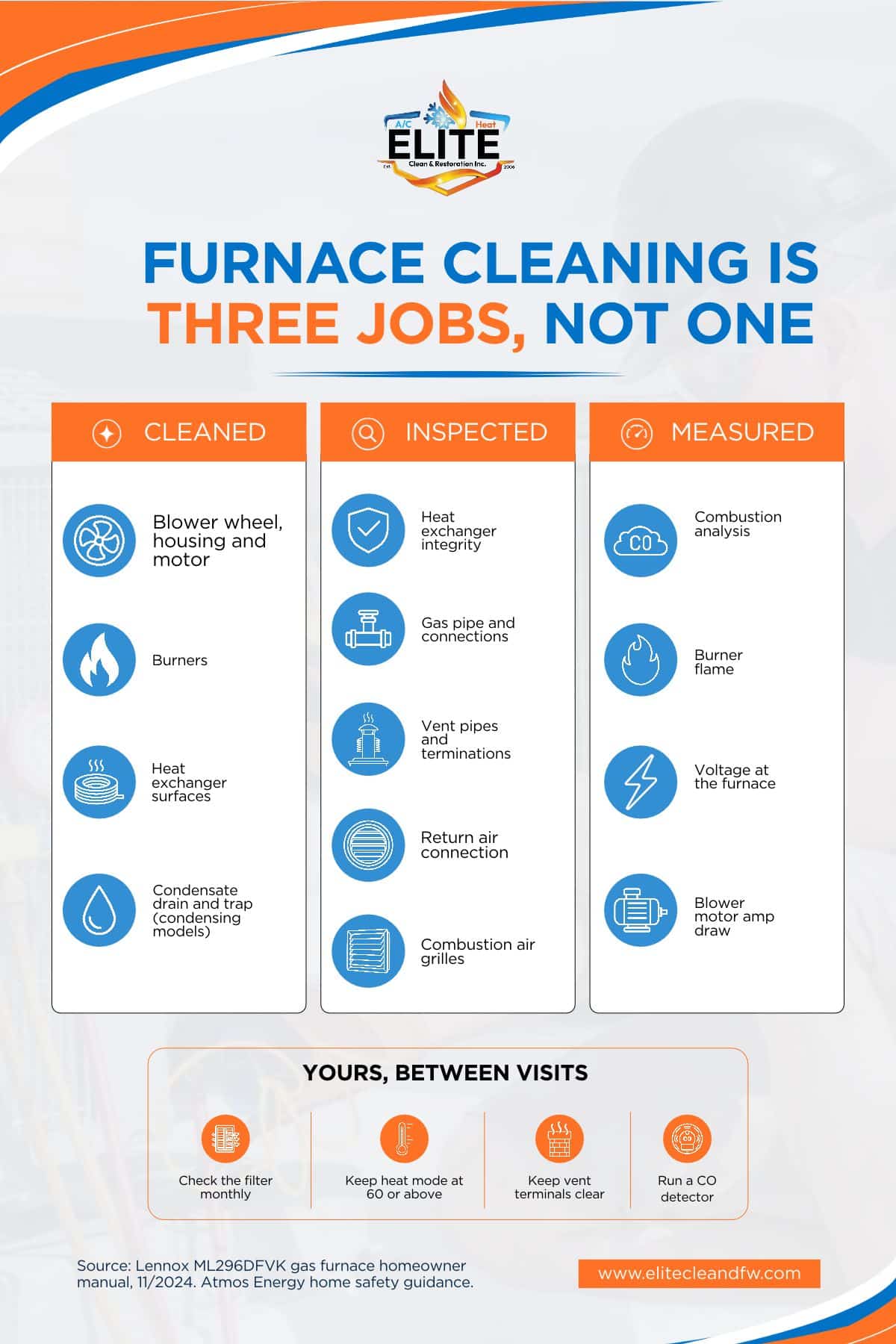
A furnace cleaning should follow the manufacturer’s list, not a coupon’s. We use Lennox’s current homeowner manual as our reference because it is specific and up to date: the Lennox homeowner manual for its ML296DFVK gas furnace, dated November 2024, spells out what an annual visit at the start of each heating season should cover. We are a listed Lennox dealer, but the list reads the same for whoever built your furnace.
Pulled from that manual, the cleaning items are:
| Part | What the manual says to do |
|---|---|
| Burners and heat exchanger | Check condition and cleanliness; clean if necessary |
| Blower assembly | Check cleanliness; clean the housing, blower wheel, and blower motor if necessary |
| Condensate drain and trap | Inspect for leaks and cracks, clean, and prime the trap with water |
| Pressure switch hoses | Inspect for cracks, remove from the header box, and clear any blockage |
| Filters | Check cleanliness, change if necessary (monthly) |
Two notes on that table. The drain, trap, and hose items apply to a condensing furnace like the one in that manual, which drains water, and many older attic furnaces in the area are not that type, so a technician skips what the unit does not have. And “clean if necessary” is the honest wording. A blower wheel that is clean does not get scrubbed to justify the visit.
What Gets Inspected, and Why a Crack Matters More Than Dust
Dust costs airflow. A cracked heat exchanger can put combustion gases, including carbon monoxide, into the airstream. That is why the inspection half of a furnace visit is the part we would never let a customer skip, even if the cabinet looked spotless.
The same Lennox manual lists what a technician inspects before each heating season:
- The furnace venting system, vent cap, heat exchanger, and burners, for corrosion, deterioration, or debris.
- All gas pipes and connections, for leaks.
- Thermostat wires and sensors, for damage.
- The intake and exhaust pipes and their terminations, for holes, blockage, leakage, and correct slope.
- The return air duct connection, to confirm it is sealed to the furnace.
- Fresh air grilles and louvers, to confirm the furnace has enough combustion air.
Item 6 matters more in a closet install than an attic one. A hall closet with a solid door and a stack of storage boxes in front of the grille is a furnace short of combustion air.
The heat exchanger procedure has a name
The manual does not leave the heat exchanger to guesswork. It tells technicians to evaluate heat exchanger integrity using the industry procedure published by the Air-Conditioning, Heating, and Refrigeration Institute, which is AHRI Guideline X, covering induced draft furnace heat exchangers, current edition 2023. Ask whoever inspects your furnace whether they follow it. A straight answer to that question tells you a lot about the visit you are paying for.
If an inspection does find a crack, we show you where and explain the options, and our furnace repair in Rowlett page lays out how we approach repair versus replacement.
What Gets Measured With Instruments
Some checks cannot be done by eye. The manual names these as annual items:
- A combustion analysis, which reads what is coming out of the flue
- The burner flame, checked by a technician rather than guessed at through the sight glass
- Voltage at the furnace while it runs
- Amp draw on the blower motor, compared against the motor nameplate
- Wiring connections, checked for looseness
The amp reading is where a loaded blower wheel shows up in numbers before it shows up as a failure.
What Belongs to You Between Visits
A once-a-year visit does not replace the few things a homeowner should do in between. The manual is clear that the maintenance procedures inside the cabinet are for a licensed technician only, and the owner is told not to attempt to service the unit. That still leaves a short list.
- Look at the filter every month. The manual says to inspect filters monthly and clean or replace them when necessary, and a filter must be in place whenever the unit runs.
- Match the filter the installer supplied. The manual warns that replacement filters with higher filtration ratings may restrict airflow, reduce performance and lead to premature blower motor failure, so a thicker pleated filter is not automatically better for the furnace.
- Leave the thermostat at 60 or above in heat mode. The same manual warns that setting it lower reduces heating cycles and can damage the unit.
- Walk outside and make sure the intake and exhaust terminals are not blocked, in any season.
- Run a carbon monoxide detector. Lennox recommends one even in homes without gas appliances.
That list is short on purpose. Taking the blower door off a gas furnace is not a weekend project, and the manual says the blower access panel must be in place whenever the blower and burners run.
Who Answers for the Gas Line Past the Meter?
You do. This is the local fact most homeowners in the area have never been told. Atmos Energy is the natural gas utility for Rowlett, and its home safety page says customers are responsible for any natural gas piping on their property from the meter to the house, and that routine safety inspection and maintenance of gas appliances is also the customer’s responsibility.
The utility’s own maintenance advice matches the manufacturer’s. Its carbon monoxide safety page recommends having a trained technician inspect, clean, and tune up central heating systems, including furnaces, flues, and chimneys, every year.
| Who | What they say about your furnace |
|---|---|
| The manufacturer (Lennox manual) | Inspect and maintain every year at the start of the heating season; annual inspection is required to fulfill the limited warranty terms |
| The gas utility (Atmos Energy) | Inspect, clean, and tune up every year; piping past the meter and appliance maintenance belong to the customer |
| Us | Book it in October, before the first real cold front sends everyone to the phone at once |
When Should a Furnace in Sachse or Garland Be Cleaned?
Once a year, before the heating season starts. Both the manufacturer and the gas utility put it on an annual schedule, and the manual ties it to the beginning of each heating season. For houses around Lake Ray Hubbard, that means October: after the air conditioner has done most of its year’s work on the blower, and before the first cold front puts every furnace in Dallas County and Rockwall County to work on the same night.
We schedule the fall visit in October for exactly that reason, and our Sachse heating work runs on the same calendar as Rowlett. An appointment made while it is still warm is an easier appointment to get.
If you are not sure whether your furnace was looked at last year, treat it as not. Our write-up of the five warning signs we see in DFW furnaces covers what an overdue unit tends to do first.
Things that should not wait for October
The manual lists conditions that mean shut the unit down and call for an inspection now, whatever the month:
- New or unfamiliar sounds, repeatedly, while the unit runs
- Unusual odors from the furnace
- Visibly burnt components, or unusual dirt or rust on the vent pipe or in the unit
- Unusual amounts of condensation on the inside of your windows
- Headache, nausea, fatigue, or dizziness at home that eases when you leave the house
That last item is the one that matters most. The manual notes carbon monoxide exposure is often mistaken for the flu, so symptoms that fade when you are away from home deserve a phone call rather than a wait.
And if you smell gas, the manual’s instructions come first: do not light anything, do not touch electrical switches, leave the building, and call the gas supplier from outside.
Book Furnace Cleaning Before the First Cold Front
A furnace cleaning worth paying for has three parts. The blower, burners, and heat exchanger get cleaned where they need it. The heat exchanger, gas connections, and venting get inspected against a written procedure. The combustion, voltage, and motor draw get measured with instruments. If a quote only mentions the first part, ask about the other two.
Our own fall safety visit is built the same way: heat exchanger crack check, igniter and burner box for rust or soot, safety switch test, breaker amperage, circuit board, thermostat, return grilles, fan motors, a standard filter replacement, and the drain lines, at $79.95. For most homes in Rowlett, Sachse, Garland, Rockwall, and Mesquite, the right time is October, and the right order is furnace first, ducts only if there is a duct problem. If you want us to handle the fall visit, Elite Clean and Restoration works out of our Rowlett shop and can put the inspection on the calendar while the weather is still warm.


