




 972-475-4949
TL;DR
When a thermostat starts acting weird, the problem is either in the thermostat or in the system it controls. The thermostat is just where you notice it. Those two need different fixes. We’ll figure out which one you’ve got and take care of it, whether that’s calibration, wiring, a replacement, moving it somewhere it can read the room properly, or setting the schedule to match how your family actually lives. Give us a call at any point. We’ve been looking after homes across Dallas-Fort Worth since 2006; same-day service is available on most calls placed before noon, and you’ll get a straight answer either way.
You’re in the Right Place
Your thermostat is the one piece of your heating and cooling system you touch every day, so when something feels off, it’s usually the first place you look. That instinct is right. It’s also the piece that gets the least attention from anyone, which is why so many comfort problems trace back to it.
What follows is everything we’d tell you if you called us this afternoon. What each symptom means, the handful of things worth trying yourself, the settings questions we’re asked most, and where we come in.
How We Can Help With Your Thermostat
This is a real service line for us, not something tacked onto the end of a repair call. Here’s what we take care of.
- Working out whether the trouble is the thermostat or the system it’s controlling
- Calibrating one that’s reading a different temperature than the room it’s in
- Checking and correcting the wiring, connections and power behind the unit
- Replacing one that’s genuinely reached the end, and matching the replacement to your equipment
- Moving one that’s mounted somewhere it can’t read your home accurately
- Setting up the schedule so your system runs when you’re home and takes it easy when you’re not
- Telling you whether a smart thermostat will work with what you already own, before you buy one
- Testing the rest of the system while we’re there, since the thermostat is often where something else shows up first
You’ll know what anything costs before we start, and you’ll get a written summary of what we checked and found that’s yours to keep.
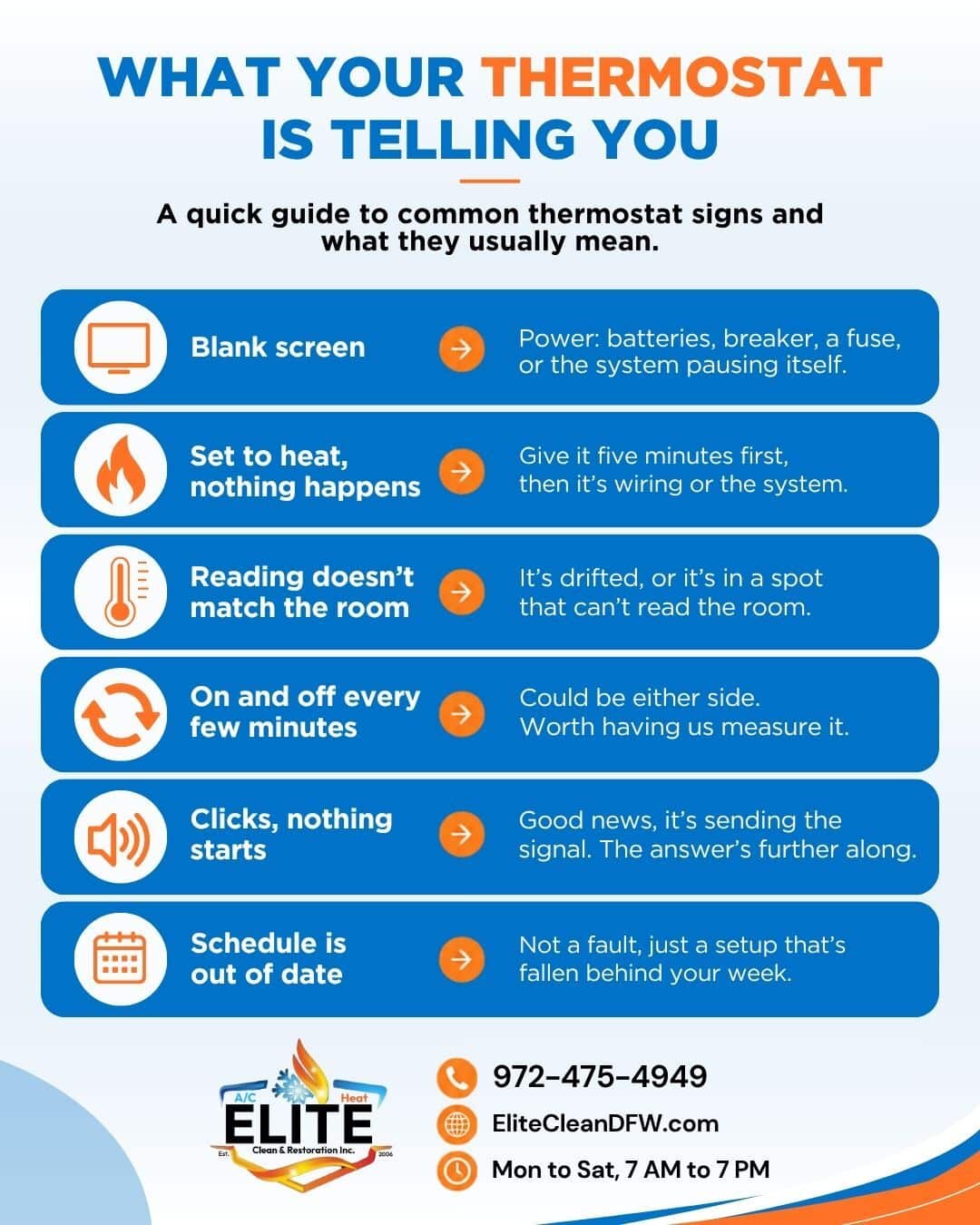
What Your Thermostat Is Telling You
You don’t need to work out the cause before you call. Just describe what you’re seeing and we’ll know what to bring. Here’s what each of these usually points to, so you’ve got some context either way.
The screen is blank
Nothing on the display at all. That’s almost always about power reaching the unit, and there are a few places it can stop: dead batteries if yours takes them, a tripped breaker, a small fuse on the control board, a wire that’s worked loose behind the plate, or a safety switch that’s paused the system because something else wants attention first.
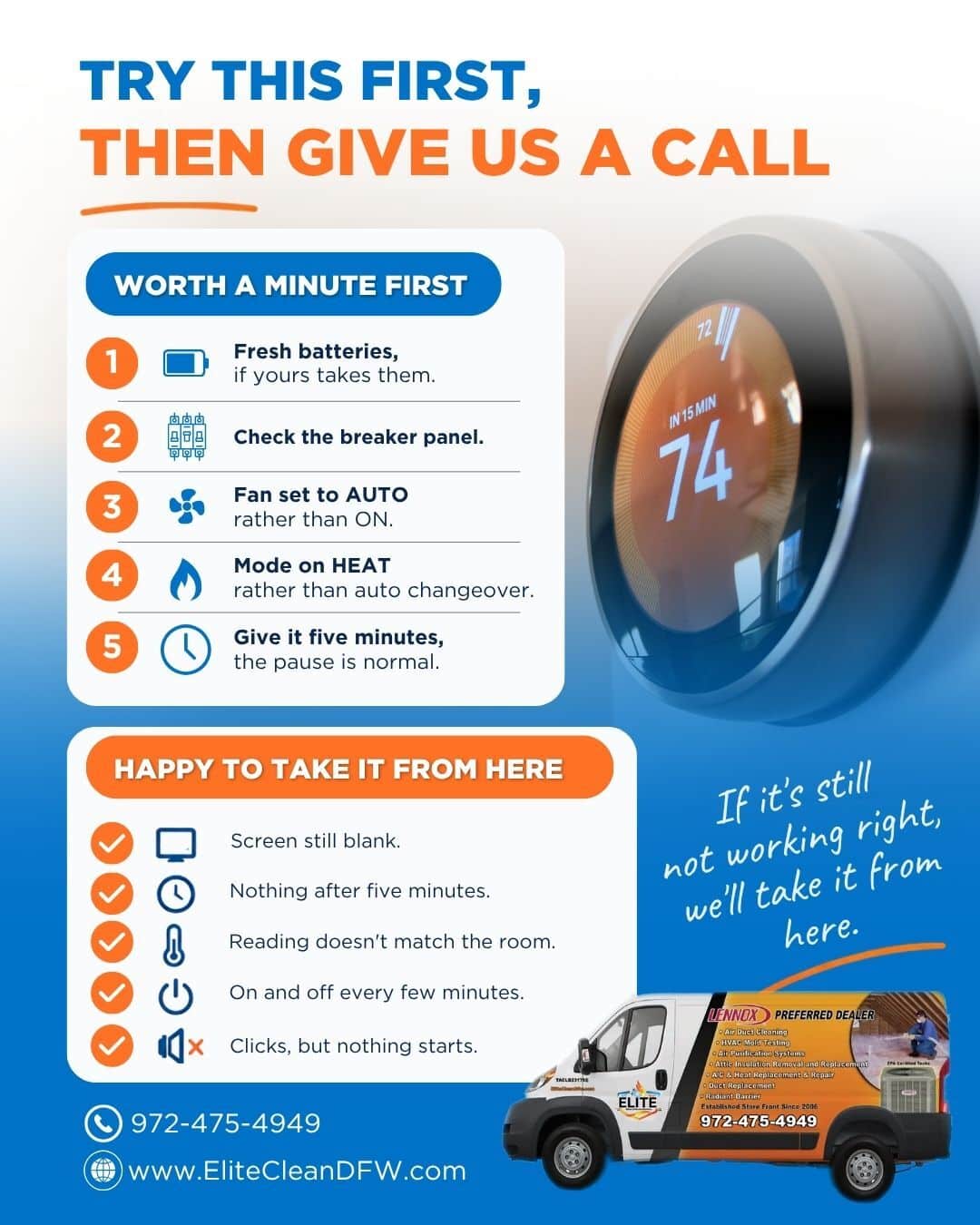
That last one is worth knowing about rather than worrying about. It’s your system looking after itself, and once we clear what prompted it, everything comes back. Try fresh batteries and check the breaker panel first. If neither brings it back, we’ll trace the power from the panel through to the unit, find exactly where it stops, and fix it from there.
It’s set to heat, and nothing happens
You’ve moved it over, nudged the temperature up, and the house hasn’t changed. Before anything else, give it five minutes. A lot of systems wait a few minutes between the call for heat and the blower starting, so what reaches you is properly warm air instead of a cool blast. That pause is built in on purpose. It isn’t a fault.
If nothing’s happened after five minutes, the usual explanations are a wiring connection, a thermostat that’s reached the end of its life, or the system not acting on the call. We’ll confirm the thermostat is sending the signal, then follow it through to the equipment and see what’s receiving it. That narrows a vague complaint down to one specific thing quickly, which is the difference between a straightforward fix and a guess.
The reading doesn’t match the room
It says 71 and the room feels more like 66. Thermostats can drift over the years, and when one does, your home sits at a temperature you never actually asked for. It’s one of the more satisfying things we fix, because you feel the difference the same evening.
There’s a second possibility we’ll rule out while we’re there. Sometimes the thermostat is reading its own spot on the wall accurately, and that spot just isn’t representative of the rest of the room. We’ll check the reading against a calibrated instrument in the same place, correct the offset where the unit allows it, and let you know which of the two you’re dealing with before we leave.
It turns on and off every few minutes
The system starts, runs briefly, stops, and starts again. Short bursts like that rarely get a home comfortable, and your equipment would much rather run in longer, steadier stretches.
This one can come from either side. A thermostat that’s drifted or sits in an awkward spot will do it, and so will airflow or the equipment itself. Because the causes sit on both sides of the wall, we measure the cycle, check the thermostat’s placement and calibration, then look at airflow and the system. We’d rather rule things out in order than swap parts and hope.
It clicks, but nothing starts
You hear the click when you change the setting, which is good news in a small way. It means the thermostat is doing its job and sending the signal. Whatever isn’t responding sits further along, usually a specific component on the equipment side, and that usually comes down to one specific thing once somebody puts a meter on it.
The schedule doesn’t match your life anymore
Not a fault at all, just a setup that’s fallen behind. Schedules get programmed once and then stay exactly that way through a job change, a new baby, a household that started working from home, or a season that runs differently than the one it was built around. If your system is heating an empty house every afternoon, you’d never know from anything except the bill.
We’ll sit down with you, set it to your actual week, and show you how to change it yourself so you’re not calling us the next time your hours shift.
Which Kind of Thermostat Do You Have?
The kind on your wall changes what can go wrong with it and what it takes to put it right. Here’s how to tell.
A dial, a slider, or a lever
No screen, no buttons, just a mechanical control you move by hand. Some of these are remarkably durable. What they can’t do is run a schedule, and they need to sit level on the wall to read correctly, so if yours has been bumped over the years, that alone can throw the reading off.
A screen with buttons and a schedule
Programmable, usually battery-backed, and the kind we see most in homes around here. These do everything a household needs as long as the schedule inside them still matches the household. The two faults we find most are a drifted reading and a program nobody has looked at in years.
A touchscreen that connects to your phone
Smart or learning thermostats. The unit itself is rarely the issue. The wiring behind it is where the trouble usually sits, and one fitted without the constant power wire it wanted may be running off a workaround that was fine on day one and less fine three years later.
A panel that came with the system
Some equipment comes with a control that only speaks to that specific system, often in a zoned or variable-speed setup. These can’t be swapped for something off a shelf, and putting a standard thermostat in place of one is a common reason a zoned home starts acting strange. If yours looks like part of the system rather than a separate device, mention that when you call.
The Settings Questions We’re Asked Most
Should the fan be on AUTO or ON?
AUTO is the setting you want for day-to-day running. On AUTO, the blower runs only while your system is actively heating or cooling. On ON, it runs continuously, which means it keeps moving air between cycles, and that air is room temperature. It’s a common reason people call to say their heat is blowing cold, when the real answer is just a switch position.
Running the fan continuously does have genuine uses, like evening out temperature across a floor plan or moving air through your filter more often. If that’s why it’s set there, you’re fine. If nobody remembers setting it, AUTO is the better place for it.
What temperature should I set it to in winter?
That’s your call, and we’re not going to tell you how to live in your own home. The thing worth knowing is that the bigger the gap between your setting and the temperature outside, the harder your system works. Easing it back while you’re asleep or out is where the savings actually come from, rather than from landing on one particular number.
If your household can’t agree on a number, that’s often a sign that one part of the house isn’t keeping up with the rest rather than a difference in taste. Mention it when you call, because that’s a very fixable thing.
Is it cheaper to leave it at one temperature all day?
You’ll hear that bringing a house back up costs you more than you saved letting it drift. On a standard system, that doesn’t hold up. Letting your home drift a little while you’re out and bringing it back when you return costs less than holding it steady all day.
Heat pumps are the one exception worth knowing about. Big setbacks can call in the backup heat during recovery, which eats into the savings, so gentler setbacks work better on those. Not sure which you have? We can tell you in about five minutes.
What does HOLD do?
It parks your programmed schedule and keeps the current setting until you cancel it. Handy when you’re home on an unusual day. Less handy when somebody pressed it months ago and the schedule you carefully set up hasn’t run since.
What’s the difference between HEAT and AUTO?
HEAT means your system only heats. AUTO, sometimes called auto-changeover, lets it pick between heating and cooling depending on where the temperature lands.
Auto-changeover sounds convenient, and during a stretch of swinging weather it can be. It also means your system might swap between heating and cooling in the same day over small swings in temperature, which makes it harder to tell what’s going on if something does feel off. Choosing a mode in the morning and adjusting from there is usually the simpler path.
Why is there a delay before anything happens?
Your system waits a few minutes between the call and the blower starting so the air that reaches you is properly warm. There’s also a built-in pause that stops the equipment from restarting immediately after it shuts down, which protects the compressor. Both are deliberate. If you change the setting and nothing happens right away, that’s usually your system doing exactly what it should.
How often do the batteries need changing?
If yours takes them, once a year is a good habit, and doing it before the heating season beats finding out at an awkward hour. Some units warn you on the display first, and some go straight to blank. Plenty of thermostats don’t use batteries at all and draw power from the equipment instead, and on those a blank screen points somewhere else from the start.
Should I turn it off completely when we travel?
Easing it back works better than switching it off. Off means nothing’s conditioning the house at all, and a setback still keeps your home in a comfortable range while cutting what you spend while you’re away. Set it back, enjoy the trip, and come home to a house that’s easy to bring back up.
The Words on Your Display, Translated
Thermostats say things in shorthand, and the shorthand isn’t always friendly. Here’s what the ones we get asked about actually mean.
EM HEAT or EMERGENCY HEAT
You’ll only see this on a heat pump. It shuts the heat pump off and runs your backup heat by itself, which warms the house but costs noticeably more. It’s there for the day the heat pump genuinely can’t do the job. If yours is sitting on EM HEAT and nobody put it there on purpose, switch it back to HEAT and give us a call, because something prompted that.
AUX HEAT
Also heat pump territory, and this one is normal. It means the backup heat is helping out alongside the heat pump, which is exactly what it’s for during a cold morning. Seeing it on a genuinely cold morning is your system working properly. Seeing it on a mild afternoon is worth a look.
RECOVERY or EARLY START
Your thermostat has worked out how long your house takes to warm up and started a little early, so you hit your target at the time you asked for it rather than an hour later. Nothing to fix. It’s one of the genuinely nice features on a programmable unit.
HEAT ON or COOL ON, with nothing happening yet
That’s the thermostat confirming it’s made the call. The delay before you feel anything is the pause we mentioned earlier. If it still says HEAT ON ten minutes later and the house hasn’t moved, that’s the point to pick up the phone.
A blinking symbol, or a flashing display
Blinking usually means a timer is running or a lockout is in place, both of which are protective. Different brands use different patterns for different things, so there’s no single translation, and we’d rather tell you what yours means than have you guess at it.
FILTER or SERVICE
A countdown somebody set, not a fault your system detected. It doesn’t know what your filter looks like. Change the filter if it’s due, clear the reminder, and if you’d like the reminder set to a realistic interval for your home, we’ll do that while we’re there.
Where Your Thermostat Lives Matters
A thermostat reports the temperature wherever it happens to be mounted. When that spot doesn’t represent the room it’s controlling, your whole home takes its instructions from a reading that was never quite right, and adjusting the number won’t get you there.
Spots that tend to cause trouble: a wall that catches direct afternoon sun, somewhere above or near a supply vent, an exterior wall, a hallway that runs warmer or cooler than the rooms around it, close to a lamp or a television, above a fireplace, or anywhere in the path of a draft from the front door.
This is one of our favorite fixes. Somebody calling about a house that won’t hold temperature is usually bracing for something major, and moving a thermostat costs a fraction of that. We’ll tell you what moving it would involve before you commit to anything. If you’ve ever looked at yours and thought it was in a strange place, say so. You’re probably right.
When One Room Never Matches the Display
This one gets blamed on the thermostat constantly, and the thermostat is almost never the culprit. The display says 70, the back bedroom is nowhere close, you push the setting up, the rest of the house overshoots, and now you’re paying to overheat five rooms so one of them is bearable. A number can’t solve a delivery problem, and that’s what this is.
Usually it’s a duct run so long that it loses most of its air before it reaches the room, a section that’s come apart at a joint, old tape that’s given up, a flexible run squashed behind something in the attic, or a room with a supply vent and no return.
We measure airflow room by room rather than taking the thermostat’s word for it, then tell you whether the answer is air duct repair or cleaning, a balance adjustment, insulation, or something else. If you’ve been quietly putting up with one uncomfortable room, mention it when you book. It changes what we bring with us.
Two Thermostats, Two Different Answers
Plenty of two-story homes here run zoned systems with one thermostat upstairs and another downstairs, and that setup has its own quirks.
The ones we see most: two thermostats set to temperatures so close together that heat moving between floors keeps triggering both, one zone responding while the other doesn’t, a damper that’s stopped moving so a zone sits open or closed no matter what its thermostat asks, or a replacement thermostat fitted on one floor that doesn’t support zoning and quietly confuses both.
We test both thermostats, check the zone controls and the dampers they operate, and make sure the two are set up to work together. Upstairs and downstairs shouldn’t need the same number to feel the same, and part of what we do is get you to a pair of settings that actually suits your home. If you’ve got two and only one is misbehaving, tell us when you call. It points us somewhere specific before we even arrive.
If Yours Is an Older One
If yours is a dial or a slider rather than a screen, it may well still be reading accurately. Age on its own isn’t a reason to replace anything, and we’ll tell you so if that’s what we find. What does make a replacement worthwhile: it’s drifted and won’t hold calibration, you’d get real value from a schedule it can’t run, it doesn’t support equipment you’ve since upgraded, or it needs to sit perfectly level and gets knocked every time somebody dusts.
One small practical note. Older mercury thermostats shouldn’t go in the household trash, since mercury needs proper disposal. When we replace one, we take it with us and handle that for you.
Will a Smart Thermostat Work With My System?
Worth asking before you buy one, because the answer isn’t always yes. If you’re weighing it alongside a system upgrade or new installation, ask about both at once. The usual sticking point is wiring. Many smart thermostats need a constant power supply from the equipment, and plenty of older installations never had that wire run to the thermostat. Multiple stages, a heat pump with backup heat and zoned setups each need a thermostat that supports them, and the wrong pairing gives you something that technically works while never quite doing what you asked.
It’s also worth being clear about what one will and won’t do. A smart thermostat is good at running a schedule you’d otherwise forget and letting you adjust things from your phone. It won’t even out the temperature between rooms or make up for ductwork that isn’t delivering, because those are different problems with different fixes.
Is It the Thermostat, or Is It the System?
This is the question sitting underneath almost everything on this page, and it’s why we diagnose rather than guess.
A thermostat is an inexpensive part, so replacing one is an easy sale and a tempting shortcut. The trouble comes when it gets swapped because it looked like the problem; the symptom carries on because the real cause was elsewhere, and now there’s a new unit on the wall, and nothing’s changed.
It goes the other way just as often. Somebody braces for a major repair, and the answer turns out to be calibration, a loose wire, or a unit that had simply come to the end of its run. That’s a good day, and it happens more than you’d expect.
Our technicians test the thermostat and the system together, working from a written checklist, and tell you which side the answer is on before anybody replaces anything. A fair share of these visits end with a setting corrected and nothing bought at all.
What Happens When You Call Us Out
You call or book online and a real person takes the details. Tell us what the thermostat is doing in your own words.
You get an arrival window you can plan around and a call before the technician sets off. An EPA-certified technician arrives in a marked vehicle and works from a written checklist rather than from memory. They’ll test the thermostat, then follow the signal through to the equipment. That second step is what tells you which side the fault is on.
Then they’ll walk you through what they found, in plain language, with the price before any work starts. If you’d rather think about it, think about it. Nobody is going to lean on you in your own kitchen. You’re left with a written summary of what was checked, which is yours to keep.
What We Check While We’re There
Because the thermostat is often where something else shows up first, a visit doesn’t stop at the wall. This is the same ground our heating and cooling maintenance visits cover, and here’s what gets a look.
- Power and the low-voltage side, including the fuse on the control board and the wiring between the thermostat and your equipment
- Whether the equipment is acting on the call it receives, and if it isn’t, which part is holding things up
- Airflow through the system, since restriction can look a lot like a thermostat fault
- Filter condition, which is the most common cause of restricted airflow and the easiest thing to put right
- Safety switches and drainage, since a switch that’s paused the system reads as a dead thermostat
- Cycle length and how your system behaves across a full call for heat
- On a heat pump, whether the backup heat comes on when it should and stays off when it shouldn’t
You get all of it in writing, with a clear split between what wants attention now, what can wait, and what’s perfectly fine. That last group matters as much as the others, because knowing where you don’t need to spend is genuinely useful.
Ahead of the First Real Cold Morning
North Texas gives you a generous window here, and it’s worth using. The air conditioning does the heavy lifting well into fall, the heat sits unused for months, and then one cold morning it’s asked to work for the first time since late winter. That first call for heat is when most thermostat faults show themselves.
The easy version is to test it now. Switch it over to HEAT, nudge it a few degrees above the room, and wait five minutes. If warm air arrives and the house responds, you’re set. If nothing happens, or it runs briefly and stops, or the screen goes blank when it tries, you’ve found it on a mild afternoon instead of a cold Saturday night, and that’s a much better position to be in.
A brief burning smell on the first run is usually dust on a heat exchanger that’s been idle all summer and should clear within a few minutes. If it doesn’t clear, or you smell gas at any point, leave it off and call us.
Finding something now means we come out on a normal schedule with the part in stock. Finding it during the first hard freeze means waiting in line behind everybody else who put it off.
Just Moved In?
New-to-you homes bring a lot of these calls. You’ve inherited a thermostat somebody else set up, running a schedule built around a household that isn’t yours, on equipment nobody has told you much about. Worth knowing early: whether it’s reading accurately, whether it suits the equipment it’s controlling, whether you’re on a heat pump or a furnace, and whether there’s a second thermostat somewhere doing something you haven’t spotted yet.
We’ll identify what you’ve got, set it up around how you actually live, and leave you with a written baseline of where the system stands. New owners often pair that with an air duct cleaning while they don’t yet know what the last household left behind. That record earns its keep a year or two later when something changes, and you want to know whether it’s new.
How Long Does a Visit Take?
People ask about time more than almost anything else, usually because they’re working out whether they need to take a morning off. A straightforward diagnosis is short. Testing the unit, checking the wiring, verifying the reading, and confirming your system is responding is quick work for somebody who does it daily, and calibration or a replacement adds a little.
What makes a visit longer is a fault that turns out to sit on the system side, a relocation where the wiring run is awkward, or a zoned home where two thermostats and the controls between them all want testing. Either way you get a real arrival window rather than a vague all-day wait, and if we need a part, you’ll know what it is and how long it takes to get.
When to Give Us a Call
Today
- The screen is blank and batteries and the breaker didn’t bring it back
- It’s set to heat and nothing’s happened after five minutes
- Your system is running but the air coming out isn’t the right temperature
- You’re hearing something new from the equipment
- Your home isn’t holding a comfortable temperature
Worth booking in this month
- The reading doesn’t match how the room feels
- It’s cycling on and off every few minutes
- It’s mounted somewhere that never quite made sense
- Your schedule hasn’t matched your household in a while
- You’re thinking about a smart thermostat and want to know if yours will take one
- One room never matches the display, whatever you set
For anything in the first list, same-day service is available on most calls placed before noon, and our HVAC repair team covers the whole metroplex. For the second list, we’ll find a time that suits your schedule.
Why Homeowners Call Us
We’re a family-owned company based in Rowlett, and we’ve been keeping homes across Dallas-Fort Worth comfortable since 2006. That’s nearly twenty years of neighbors calling us back and sending us to their friends, which is the only kind of growth we’ve ever really gone after.
If the honest answer is that everything’s in good shape and the fix is a setting, that’s what you’ll hear. That approach is how we’ve ended up with a 4.8 rating across more than 1,295 reviews, and we’d rather protect that than squeeze anything extra out of one visit.
- Family-owned and based in Rowlett, looking after DFW homes since 2006
- 4.8 rating across more than 1,295 Google reviews
- EPA-certified, fully licensed technicians · Texas TACLB #TACLB023175E
- Lennox Preferred Dealer and Google Guaranteed, and we service Trane, Carrier, Rheem, Goodman, American Standard, York, Bryant, Amana, and Daikin
- Heating and cooling, air ducts, dryer vents, insulation and air purification, all from one team
- Same-day service on most calls placed before noon, Monday through Saturday, 7 AM to 7 PM
- Upfront pricing before we start and a written summary after every visit
- 100% Satisfaction Guarantee on every job, financing available, and a Veteran’s Discount year-round
Book a Thermostat Visit
A thermostat that’s telling the truth about your home makes everything downstream easier. Your system runs when it should, your rooms feel the way you set them, and you stop thinking about it altogether, which is the whole point.
Tell us what yours is doing, and we’ll take it from there. No obligation, no pressure, and a straight answer whichever way it goes.
Call 972-475-4949 or book online at EliteCleanDFW.com · Same-day service on most calls before noon · Monday through Saturday, 7 AM to 7 PM · Looking after homes in Dallas, Fort Worth, Plano, Frisco, Rockwall, Richardson, Garland, Mesquite, Sachse, Sunnyvale, Grand Prairie, and Rowlett.


