



 972-475-4949
Old attic insulation that is dry, clean, and free of animal waste can stay where it is, and new insulation goes over it. Three findings change that answer: water, rodents, and a pebble-like fill called vermiculite.
Each of the three has its own rule, and only some of that work belongs to an insulation crew. What the old material looks like decides the job. Age doesn’t.
TL;DR
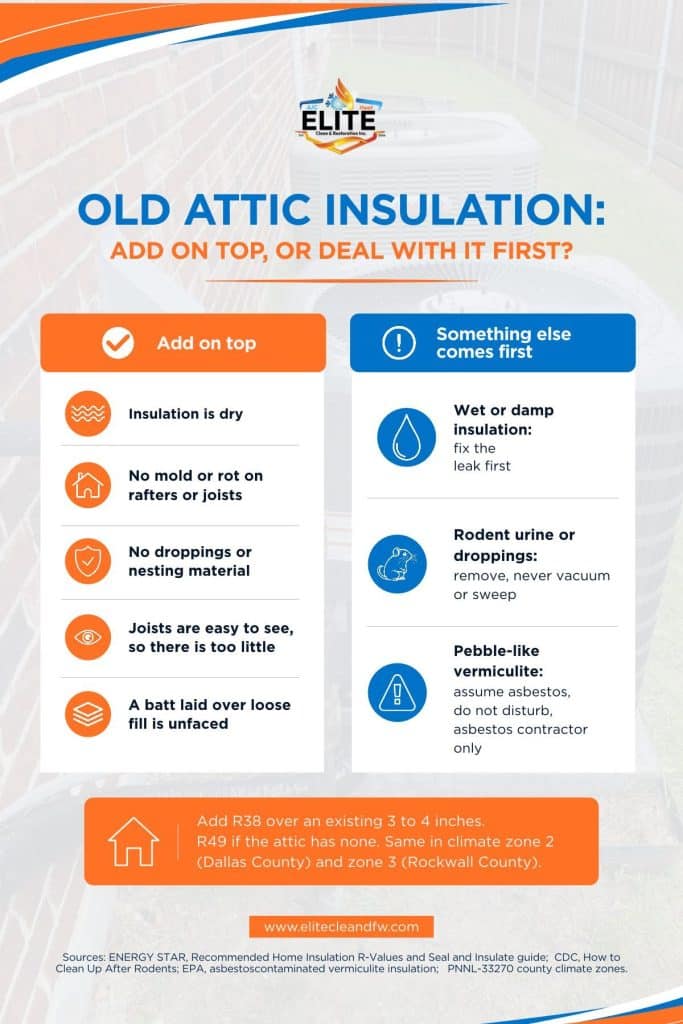
Whether to remove old attic insulation or add on top depends on the condition of the material, and age has little to do with it. Dry, clean insulation stays, and ENERGY STAR’s retrofit table says to add R38 over an existing 3 to 4 inches in both climate zone 2 (Dallas County) and climate zone 3 (Rockwall County). Wet insulation means a roof leak or another moisture source gets fixed before anything is added.
Insulation soiled with rodent urine and droppings is bagged and removed, and the CDC says never to vacuum or sweep it. Pebble-like vermiculite is assumed by the EPA to contain asbestos, so nobody disturbs it and a trained asbestos contractor handles any removal. Ten minutes at the attic hatch with a flashlight is usually enough to tell which of the four an attic is.
Four Things an Attic Can Show You and the Three Ways It Ends
For this decision, an attic lands in one of four conditions, and each condition leads to one of three outcomes. The table below is the short version. The sections after it explain how to tell the rows apart and whose rule sits behind each one.
| What you find | What it means | Outcome |
|---|---|---|
| Dry, clean insulation that is thin or uneven | Nothing is wrong with the material; there is too little of it | Add on top |
| Wet, damp, stained, or matted insulation | Water is getting in, or moist air is being dumped up there | Fix the source first, then decide |
| Droppings, nesting material, or an animal smell | Rodent contamination | Remove, clean, then insulate |
| Loose pebble-like fill, gray-brown or silver-gold | Vermiculite, assumed to carry asbestos | Stop and leave it alone |
Look at what the table leaves out. There is no row for age.
ENERGY STAR’s own test for whether an attic needs more insulation opens with the words “no matter what kind of insulation you currently have,” and the age of the material never enters it. A blanket of fiberglass that has stayed dry for decades is judged by how deep it is today.
When Is Adding on Top the Right Call?
Adding on top is the right call when the existing insulation is dry, shows no mold or animal waste, and is not vermiculite. From there, the only question is depth. ENERGY STAR’s do-it-yourself guide gives a test anyone can run from the hatch: look across the attic, and if the insulation is level with or below the floor joists, so that the joists are easy to see, the attic should get more. If the joists are buried well below the surface, there is probably enough, and adding more may not be cost-effective.
The same page asks for one more look, toward the edges. Some attics have plenty in the middle and very little along the eaves, and an even layer is what counts.
New insulation doesn’t have to match what is already there. The guide’s rules on mixing are short:
- Loose fill can go over fiberglass batts or blankets.
- Batts can go over loose fill.
- A fiberglass batt laid over loose fill has to be unfaced, with no paper or foil backing.
Loose fill needs a blowing machine, which is why the guide suggests hiring that part out. Blown-in and batt are both things we install, and the choice depends on the attic and on what is already up there. The materials are covered on the page for our attic insulation installers.
Seal the ceiling before burying it
ENERGY STAR’s page on adding insulation begins after the air sealing is done. That order is deliberate. Once a fresh layer goes down, every gap in the ceiling sits under a foot of material where nobody will find it again.
So the gaps around can lights, the attic hatch, and the top plates get sealed first, which is how we do it on our own jobs. We covered the reasoning in our piece on why the ceiling gets sealed before a fan or anything else goes into an attic. The government guide flags two more things that should not simply be covered over: recessed can lights that are unsealed and uninsulated, which need special care, and knob and tube wiring from before 1930, which it says can be a fire hazard when in contact with insulation.
Flattened and thin are two different findings
Thin means not much was installed. Flattened means something pressed it down, and that something is usually on the list of reasons to stop: water, animals, or years of boxes stored on top.
Our Rowlett replacement page lists settled, flattened insulation among the cases for replacing instead of topping up, along with any smell that a new layer would only bury. When we see matted gray insulation, the first question is what flattened it. The answer usually moves the attic into one of the next three sections.
How Much Does a Dallas or Rockwall County Attic Need?
For an attic that already holds 3 to 4 inches of insulation, the recommendation is to add R38. For an attic with none, it is R49. Those figures come from ENERGY STAR’s table of recommended insulation levels for retrofitting existing wood-framed buildings, and they apply on both sides of the county line east of Dallas.
That line deserves a paragraph, because the table is sorted by climate zone and the zone changes at the county boundary. A county-by-county climate zone guide written by Pacific Northwest National Laboratory for the Department of Energy lists every county under the 2021 energy code map. Dallas County is shown moving from zone 3 to zone 2 in that update. Rockwall County stays in zone 3.
Rowlett sits in northeastern Dallas County and western Rockwall County, so two houses in the same city can fall in different zones. Downtown Garland is on the Dallas County side.
| Dallas County | Rockwall County | |
|---|---|---|
| Climate zone on the 2021 map | 2 (zone 3 on the earlier map) | 3 |
| Attic with no insulation | R49 | R49 |
| Attic with 3 to 4 inches already | Add R38 | Add R38 |
| Floor | R13 | R19 |
Does the zone change matter for an attic? No. Dallas County was reclassified as warmer, and the attic recommendation did not drop with it. Only the floor row differs.
Two cautions on reading those numbers. They are ENERGY STAR’s cost-effective levels for existing homes, based on a table in the 2021 International Energy Conservation Code, and they say nothing about what any city here enforces on a permit. And R-value is the target, with depth as a rough stand-in: the same program’s guide puts R-38 at about 10 to 14 inches depending on the insulation type. About R-38 is also the level our own Rowlett pages say we insulate to.
Wet, Stained or Matted Insulation Means Finding the Water First
Insulation doesn’t get wet on its own. The Getting Started page of ENERGY STAR’s sealing and insulating guide lists the attic conditions a homeowner should have a contractor correct before going any further, and most of the list is about moisture:
- Wet insulation, which points to a leaky roof
- Moldy or rotted rafters or floor joists, which point to a moisture problem
- Kitchen, bathroom, and clothes dryer vents that exhaust moist air into the attic instead of outdoors
- Little or no attic ventilation
The order matters more than the material. Blow a clean layer over a wet patch, and the stain you needed to see is gone, while the leak carries on underneath.
The dryer item is one we meet from the other direction. We have written before about a dryer vent that ends in the attic and what that hot, damp air does to the insulation around it.
Whether the wet insulation itself comes out is a second decision, made once the source is fixed. Our own rule is on the Rowlett replacement page: insulation that got wet from a roof leak and has stayed compressed or moldy gets replaced. Mold on the framing is filed by ENERGY STAR under moisture problems to correct first, and it is settled before anyone talks about R-value.
One more clue belongs here. Comfort and bills that didn’t improve after somebody added insulation on top is one of the signs our Rowlett page lists for replacement. The bill side of that is a subject of its own, and we went through how attic insulation shows up on a Texas energy bill separately.
What Do Rodent Droppings in the Insulation Change?
Droppings change the method completely. Insulation that rodents have lived in comes out, and nothing gets added over it.
The reason is in the CDC’s guidance on cleaning up after rodents: diseases are mainly spread to people from rodents when they breathe in contaminated air. Its instructions follow from that. “Don’t vacuum or sweep rodent urine, droppings, or nesting materials.”
A shop vacuum and a free Saturday is the wrong plan. The agency’s sequence runs the other way:
- Spray urine and droppings with a bleach solution or an EPA-registered disinfectant until very wet, and let it soak for 5 minutes or as the label directs.
- Wipe up with paper towels and throw them in a covered garbage can.
- Where exposed insulation is contaminated with urine and droppings, place it into plastic bags for removal.
For a heavy infestation, the same page moves to coveralls, goggles, gloves, and a respirator with a HEPA filter. Where an attic crosses into heavy is a judgment call, and one more reason this isn’t a job for a broom.
Blowing fresh material over the top fixes none of it. On our Rowlett page, we say plainly that burying the problem is the mistake we get called back to fix after other companies. This is the point where a top-up stops being the job and attic insulation removal and replacement starts.
Two things have to happen around the removal. The animals and the way they got in are dealt with first, because new insulation under an open entry point is new nesting material. And the ducts get a look. A lot of North Texas houses carry their ductwork through the attic, and the CDC says to call a rodent exterminating service when there is evidence rodents have reached the heating and cooling system.
Pebble-Like Gray Fill Between the Joists Is a Full Stop
Vermiculite is the finding that ends the inspection. The EPA’s page on vermiculite insulation describes it as a pebble-like, pour-in product, usually gray-brown or silver-gold. A single mine near Libby, Montana, supplied over 70 percent of the vermiculite sold in the United States from 1919 to 1990; that mine also held an asbestos deposit, and the product was often sold under the brand name Zonolite. The agency’s position is to assume any vermiculite insulation may be contaminated.
Its recommendations are blunt:
- Leave it undisturbed.
- Do not store boxes or other items in an attic that contains it.
- Do not let children play up there.
- Do not try to remove it yourself.
- Hire an asbestos contractor if a remodel or renovation would disturb it.
Here is the part most people get backwards. The common instinct is to get it tested and then decide. The EPA says testing is not necessary to take those precautions, that it can be expensive, and that depending on the method it might give erroneous results. Assume, and leave it alone.
That rules out both halves of this article’s title. Tearing it out is asbestos work. Topping it up means a crew walking through it and blowing material across it, and the agency warns that a contractor disturbing the insulation may send fibers into other parts of the house.
So this is the one branch where our answer is a referral. A trained asbestos contractor comes first, and insulation is a conversation for afterward. We won’t guess how many attics around Dallas, Garland, or Rowlett still hold vermiculite. The Libby mine sold until 1990, so the age of a house is a hint and nothing more.
Ten Minutes at the Attic Hatch With a Flashlight
None of this needs a crawl across the joists. Most of it can be seen from the ladder.
- Stop at the hatch and look before stepping in. If the fill is loose and pebble-like, go no further and close it up.
- Look across the span. Can you see the tops of the joists?
- Compare the middle with the edges. Thin at the eaves counts as thin.
- Check the underside of the roof for dark stains, and the insulation beneath them for damp or matted patches.
- Scan for droppings, tunnels, shredded material, and chewed duct wrap. Leave all of it where it is, with no sweeping and no vacuuming.
- Find where the bathroom fans and the dryer vent end. Outdoors is the only right answer.
- Notice the smell. Musty and animal are both findings.
Take photos of anything odd. Seven looks and a handful of pictures will place an attic in one row of the table at the top of this page.
What a Removal Job Involves When It Is Ours to Do
Our process starts with an inspection of the existing insulation and a recommendation based on its condition. When the answer is removal, the work runs in a fixed order: the old insulation comes out, whatever was going on underneath gets cleaned up, and the cause is addressed, whether that was a leak, a pest entry point, or air leaking up from the living space. Then the attic is re-insulated.
We remove fiberglass, cellulose, and blown-in insulation. Most homes are a one- to two-day job, depending on the size of the attic and what is being removed. The page on what we do on a replacement job in Rowlett sets out the same steps.
Have the Old Attic Insulation Looked at Before You Buy More
Buying more insulation is the easy part. What it would be covering is the real question, and that gets answered by looking. If the attic is dry and clean, adding on top is the right job and the old material has earned its place. If it falls in one of the other three rows, the order of work changes, and in one of them the first call isn’t to an insulation company at all.
Elite Clean and Restoration is based in Rowlett and works in Dallas, Garland, Rockwall, and the towns around them. If you’ve done the ten-minute look and aren’t sure which row you’re in, send us what you saw or have us look at what is up there. We’ll tell you whether the old insulation stays.


