




 972-475-4949
 TL;DR
A dryer vent duct can run 35 feet maximum, measured from the wall connection to the outdoor terminal, and every bend eats into that budget: 5 feet per 90-degree elbow, 2.5 feet per 45-degree elbow. Four 90s on a 20-foot run puts you at an effective 40 feet, over the limit, with a dryer that never quite finishes. The duct also has to be 4-inch rigid or semi-rigid metal, not foil, and it has to terminate at least 3 feet from any door or window. If your laundry takes two cycles even after a cleaning, measure the run before you book another one.
What Most People Check, and the One Thing They Skip
Everyone knows the symptoms. Clothes come out warm and damp. The laundry room feels like a sauna by the third load. Lint collects behind the dryer no matter how often you empty the trap.
The usual advice stops at cleaning, and dryer vent cleaning in Dallas is genuinely the right first move most of the time. It just does not explain the houses where the problem comes back four months later, every time, for years.
In those houses, the vent is not dirty. It is too long, too twisted, or made of the wrong material, and the lint is a symptom of a run that cannot move air fast enough to carry lint out of the house. A full load of wet clothes can hold as much as a gallon and a half of water, and every ounce of it has to leave through that pipe. When the run is oversized for the blower, the moisture and the lint settle in the duct instead.
That is the check nobody does, and it takes about ten minutes.
The Duct Math, and How to Run It on Your Own House
The Department of Energy’s Building America guidance puts the rule plainly: the duct from the wall to the outlet terminal should be no more than 35 feet, decreased by 2.5 feet for every 45-degree bend and 5 feet for every 90-degree bend. That mirrors Section M1502 of the International Residential Code, which is the family of code North Texas jurisdictions build from.
Here is what that does to a real run.
| Fitting or length | Counts as |
| Straight duct | Its actual measured length |
| One 45-degree bend | 2.5 feet |
| One 90-degree bend | 5 feet |
| Transition hose behind the dryer | Not counted toward the 35 feet |
| Your budget | 35 feet total |
A worked example from a two-story home
Take a second-floor laundry room in a Rowlett or Sachse two-story, which is where we see this most often. The duct leaves the wall, turns 90 degrees to get into the joist bay, runs 18 feet across the house, turns 90 degrees again to get into an exterior wall cavity, drops 9 feet, then makes a final 90 to reach the wall cap.
- Straight duct: 18 + 9 = 27 feet
- Three 90-degree bends: 15 feet
- Effective length: 42 feet
Seven feet over, and nothing about that installation looks wrong from the laundry room. The homeowner sees a clean lint trap and a dryer that takes 80 minutes.
How to measure yours without opening a wall
You do not need to see the whole duct to get a usable number.
- Find the outside wall cap. Walk the exterior and look for the flap, usually low on a wall or up near the eave.
- Stand at the dryer and pace the straight-line distance to that cap, then add for any floor change.
- Count the direction changes the duct has to make to get there. Every corner the path turns is an elbow.
- Add 5 feet per turn to your paced distance.
- Compare the total to 35.
If your number lands anywhere near 35, the run is the first thing to investigate, not the last.
Does the Hose Behind the Dryer Count Toward the 35 Feet?
No. The transition duct, the flexible piece running from the appliance to the wall, is measured separately and does not come out of your 35-foot budget. That is the good news. The bad news is that it is the single most common failure point in the whole system, and the budget it does not touch is the one it wrecks.
Why Foil Duct Fails Even When the Length Is Fine
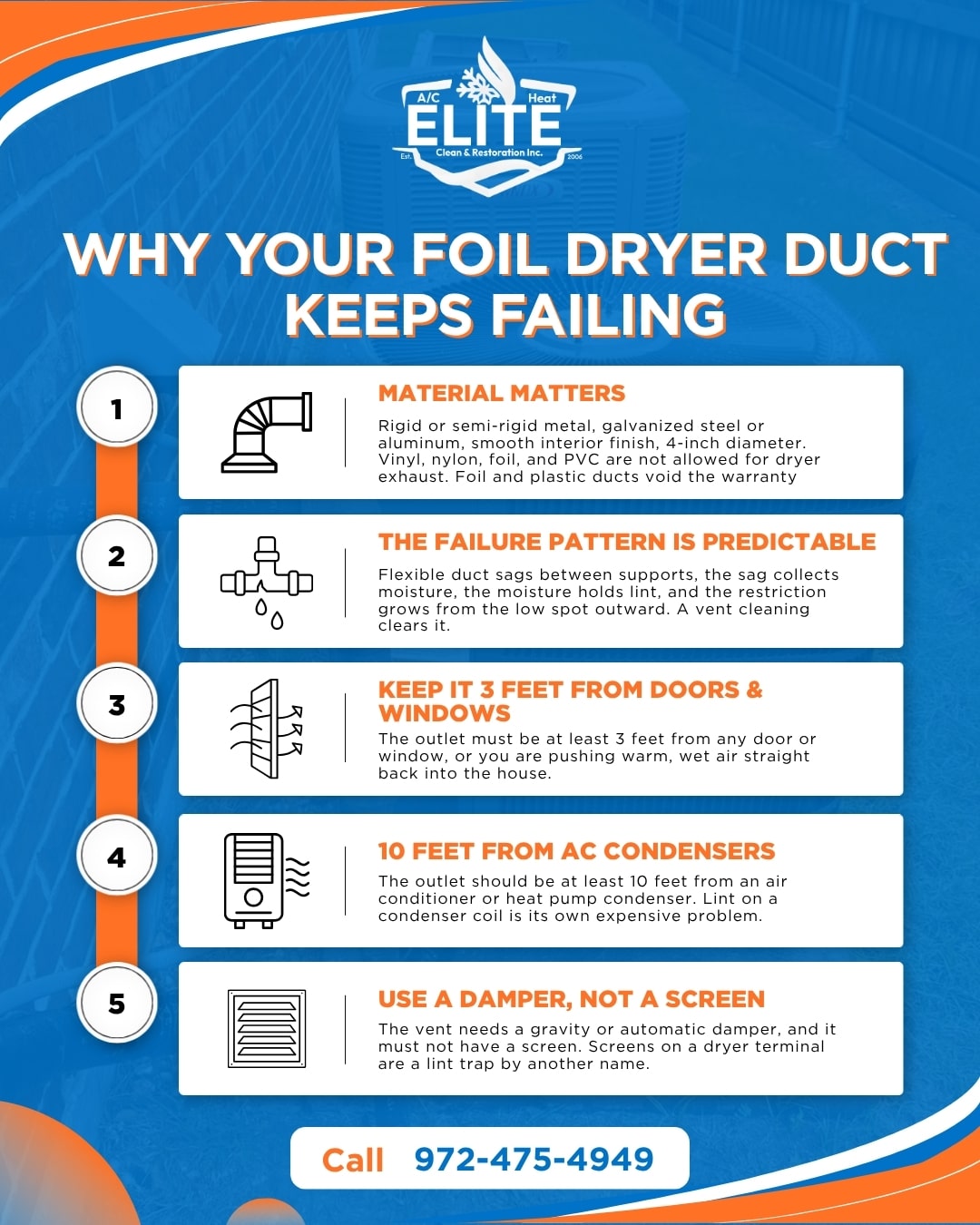
Material matters as much as distance, and this is where many older DFW homes lose out. The federal guidance is specific: rigid or semi-rigid metal, galvanized steel or aluminum, smooth interior finish, 4-inch diameter.
Vinyl, nylon, and foil are out. The spiral ribs that make flexible duct easy to install are exactly what catch lint, and the guidance notes that flexible foil and plastic ducts void the warranty on most dryers. PVC is not permitted for dryer exhaust under any standard.
The failure pattern is predictable. Flexible duct sags between supports; the sag collects moisture, the moisture holds lint, and the restriction grows from the low spot outward. A vent cleaning clears it. Four months later, the same sag has refilled.
Two other termination details get missed constantly:
- The outlet has to sit at least 3 feet from any door or window, or you are pushing warm, wet air straight back into the house.
- It should be at least 10 feet from an air conditioner or heat pump condenser, because lint on a condenser coil is its own expensive problem.
- It needs a gravity or automatic damper, and it must not have a screen. Screens on a dryer terminal are a lint trap by another name.
That last one is worth walking outside to check right now. A screened dryer cap is one of the fastest fixes on this list and one of the most common installs we find.
What the Fire Numbers Actually Say
Most articles on this topic quote a dryer fire statistic with no source and no date. The federal number is worth having straight, and it points to maintenance rather than the appliance.
The U.S. Fire Administration’s clothes dryer fire report covers 2008 to 2010, which is the most recent federal analysis published on the topic. Over that period, fire departments responded to an estimated 2,900 clothes dryer fires in residential buildings each year, causing an annual average of 5 deaths, 100 injuries, and $35 million in property loss.
The finding that matters for this article:
| Finding | Figure |
| Leading factor contributing to ignition | Failure to clean, 34 percent |
| Leading items first ignited | Dust, fiber, and lint, 28 percent |
| Second item first ignited | Clothing not on a person, 27 percent |
| Fires confined to the object of origin | 54 percent |
| Peak month | January, 11 percent |
Failure to clean leads the list, and a run that is too long or too restrictive is a machine for producing exactly that condition faster than any cleaning schedule can keep up with. The duct does not have to be neglected to fail. It has to be un-cleanable at the interval the homeowner is actually willing to maintain.
Worth being honest about the data: it is a 2012 publication using 2008 to 2010 incidents, and it is the newest federal report on clothes dryer fires available. Anyone quoting a bigger, rounder number without naming a source and a year is repeating something they read.
Ten Minutes, No Tools, Before You Book Anything
Run this before you spend money. Most of it is a walk around the house.
- Start a load on a heat setting and go outside to the wall cap. Is the flap fully open, or barely lifting?
- Hold your hand near the terminal. Weak or cool air with the dryer running on heat means restriction somewhere in the run.
- Check the cap for a screen. If there is one, that is a finding.
- Measure the cap’s distance to the nearest window, door, and the outdoor AC unit.
- Pull the dryer out and look at the transition hose. Foil or vinyl behind the machine is the single most common thing we find.
- Look at how far the hose has to stretch and whether it is crushed against the wall.
- Pace the run and count the turns, then do the math above.
- Note the drying time for a normal medium load. Under 45 minutes is healthy. Repeatedly over 70 with a clean trap is not.
Two or three findings on that list and the vent needs work. All eight, and the run itself needs redesigning, which is a different job from a cleaning.
When a Cleaning Fixes It and When It Does Not
The distinction is simpler than it sounds, and it decides what you should be paying for.
| What you found | What actually helps |
| Heavy lint, run under 35 effective feet, rigid metal duct | A cleaning. This is the common case |
| Foil or vinyl transition hose behind the dryer | Replace the hose with semi-rigid metal, then clean |
| Screened terminal or a flap that will not open | Replace the wall cap |
| Effective length over 35 feet | Reroute to a shorter path or a closer exterior wall |
| Long run you cannot shorten | Rigid metal throughout, minimum bends, and a maintenance interval built around it |
| Sagging duct in a crawlspace or attic | Support the duct properly before cleaning, or the sag refills |
A dryer vent cleaning is the right call for the first row and part of the second. The bottom three rows are ductwork, and paying for repeat cleanings on a run that is over length is how homeowners end up spending more over five years than the reroute would have cost once.
If the run does need rebuilding, the path matters more than the parts. Our step-by-step walkthrough of running a new vent line covers how the route gets planned, and the same logic applies whether the work is new or a correction. While the wall is open is also the sensible moment to look at whether the laundry room shares a return with the rest of the system, which is where air duct cleaning in Dallas and vent work overlap.
The DFW Wrinkle Nobody Mentions
Two things about this metro make the length problem worse than the national guidance implies.
The first is attic temperature. A duct running through an unconditioned North Texas attic in August is moving humid air through a space that can sit well above the outdoor temperature all afternoon. That does not change the code math, but it does change how quickly a marginal run turns into a wet one, because the air in the duct cools and drops its moisture load as soon as it hits the cooler section near the exterior wall.
The second is floor plan. Interior second-floor laundry rooms are standard in a lot of the newer Rockwall, Sachse, and Rowlett construction, and an interior laundry room is precisely the layout that produces a 40-foot effective run. It is not a defect. It is a design tradeoff that nobody explains to the buyer, and it means those homes need a shorter cleaning interval than a house with the dryer on an exterior wall.
If your attic is part of the problem, it is usually part of a bigger one. Attic heat that is cooking your vent run is also loading your cooling system, and solar attic ventilation is worth pricing at the same time. Our Rowlett HVAC Contractor looks at both on the same visit because the two problems live in the same space.
Measure the Vent Run Before You Book Another Cleaning
Start with the wall cap, because it costs nothing and it is the fastest thing to rule out. Run a load, walk outside, and watch the flap.
Then pace the run, count the corners, and do the 35-foot math. If your number is comfortable and the vent is still slow, you have a cleaning problem and an easy fix. If the number is over, you have a design problem, and another cleaning will buy you a few months at best.
Either way, you will know which conversation to have. When you want a second set of eyes on the run before you spend anything, Elite Clean and Restoration can put a tech on it, and you can book a vent inspection for a look at the whole path rather than just the opening.


