




 972-475-4949
 An attic fan moves air out of an attic. The question that decides whether it lowers your bill is not how powerful it is; it is where the replacement air comes from. If it comes through open soffit vents, you get what the fan is for. If the soffit vents are blocked and the ceiling below is leaky, the fan pulls conditioned air out of your house instead, and your air conditioner works harder. Both conditions are checkable from a ladder before anyone quotes you.
TL;DR
A powered attic fan draws air out of the attic, and something has to replace it. ENERGY STAR is explicit that where an attic has blocked soffit vents and is not well sealed from the rest of the house, attic fans will pull cool conditioned air up out of the house and into the attic, raising the summer bill rather than lowering it. The fix is not to skip the fan. It is to make sure the intake path is open, and the ceiling plane is sealed first, in that order, because that is the sequence that makes the fan do what it was bought to do.
What Is the Fan Actually Doing?
Air is not created in an attic. Anything a fan pushes out has to be replaced by an equal volume coming in from somewhere.
The government’s guidance on attic ventilation describes the intended path plainly: attic fans are meant to cool hot attics by drawing in cooler outside air from attic vents, soffit, and gable, and pushing hot air to the outside.
That is the design. Outside air comes in at the eaves, hot air goes out at the top, and the attic gets closer to outdoor temperature instead of sitting far above it.
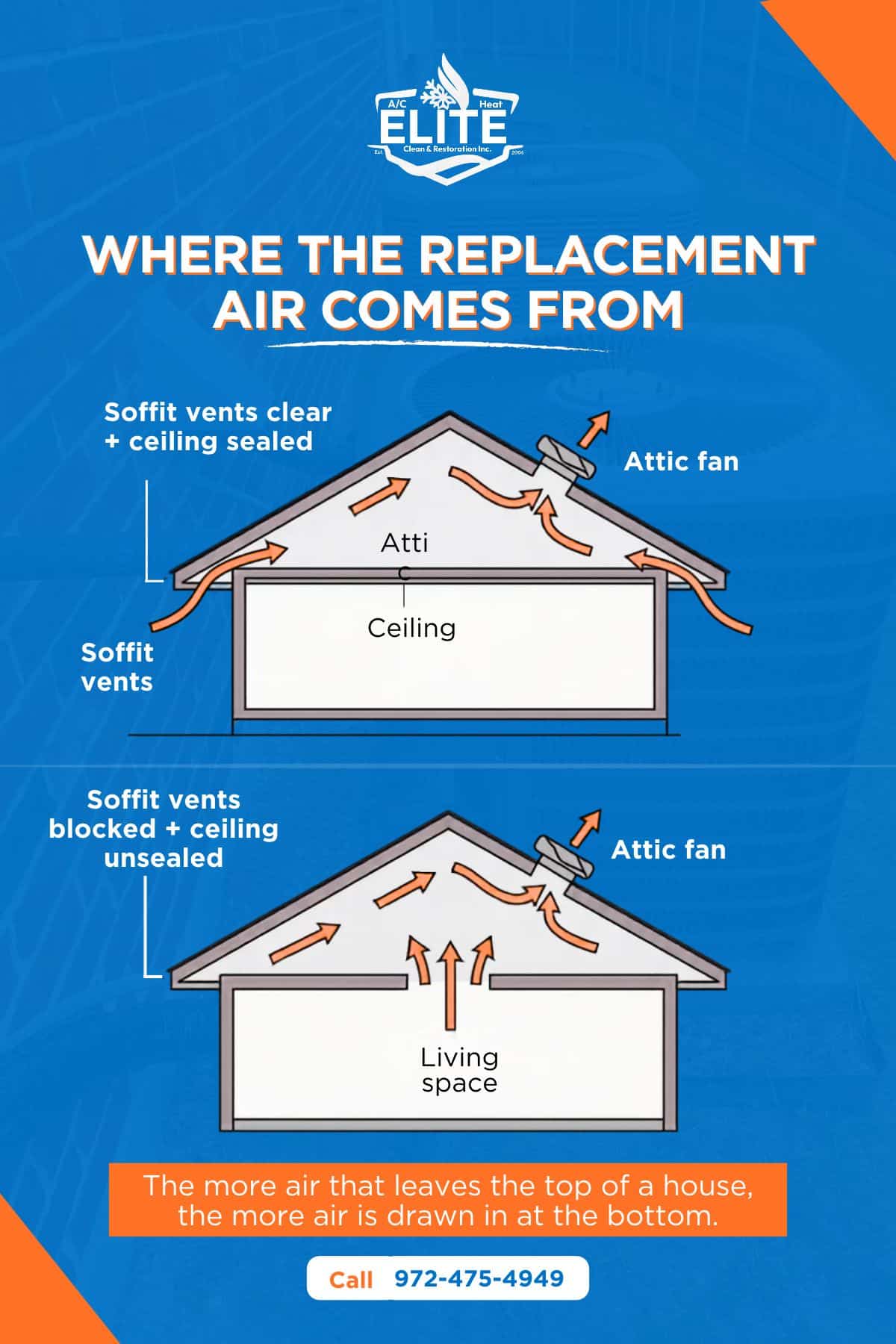
Now the failure case, in the same source’s words. Where an attic has blocked soffit vents and is not well sealed from the rest of the house, attic fans will suck cool conditioned air up out of the house and into the attic. This uses more energy and makes the air conditioner work harder, which increases the summer utility bill.
Why this is not an argument against fans
Read that carefully, and it is a conditional, not a verdict. Two conditions have to be true for the fan to work against you: blocked intake and a leaky ceiling. Neither is a property of the fan.
Both are properties of the house, both are common in North Texas housing, and both are fixable. That is why the sequence matters more than the product choice.
Are Your Soffit Vents Actually Open?
This is the first thing to check, and in a lot of houses the answer is no.
ENERGY STAR names it as the single most common mistake homeowners make when installing insulation: blocking the flow of air at the eaves. Its instruction is to never cover attic soffit vents with insulation, and to use rafter vents and soffit vents to maintain airflow.
Picture what happens on a typical insulation job. Blown insulation is added to bring the attic up to depth; the installer works out toward the edges, and at the eaves the material drifts into the narrow space where the roof deck meets the top plate. That is exactly where the intake air enters. From the ground, the soffit vents still look fine, because the vents themselves are clear. The blockage is on the inside.
The Department of Energy’s guide to attic air sealing, written by Building Science Corporation for the Building America programme, is specific about the fix: with continuous soffit ventilation, insulation baffles are required in every bay. Not most bays. Every one.
When the house has no soffit to work with
Some houses cannot take soffit intake at all, and it is worth knowing whether yours is one of them before buying anything.
The same guide notes that not all roofs can be vented with soffit vents providing the necessary inlet for intake air, because some roofs have minimal or nonexistent overhangs, or insufficient soffit area to install vents in. Where soffit venting is not possible, an alternative method of providing intake air low near the roof perimeter is needed.
A house in that category with a powered fan and no alternative intake has only one remaining air supply, and it is the conditioned space below.
Is the Ceiling Sealed?
The second condition, and the one that decides how much the fan can take from inside.
Every recessed light housing, every plumbing and wiring penetration, the top plates of interior walls, the attic hatch, and any dropped ceiling above cabinets are potential openings between the house and the attic. Individually, they are small. Together, they are the leak the fan pulls through.
The building science guide describes the mechanism in a sentence worth keeping: the more air that leaves the top of a house, the more air is drawn in at the bottom of a house, and sealing the top reduces the entry of air and contaminants at the bottom even where a hole is present down there.
A powered attic fan is a machine for taking air out of the top of a house. On a sealed ceiling, it takes it from the attic. On a leaky one, it takes some of it from your living room, and something else has to come in through the bottom of the house to replace it.
Our note on what attic insulation does for a Texas energy bill covers the insulation half of this. Sealing is the half that has to come first.
The Order of Operations Nobody Publishes
The Building America guide sets out a priority list, and it is the most useful thing in this article because it settles every argument about what to do first.
Its stated order is that health and safety issues are addressed first and matter more than durability issues, that durability issues matter more than saving energy, and that health, safety, and durability should not be traded away to save energy. So combustion safety and ventilation for indoor air quality come first. Durability and attic ventilation follow. Then, to maximise savings, air sealing is completed before insulating.
Applied to an attic fan, that gives a clear sequence.
- Combustion safety, if the house has gas appliances
- Intake ventilation, meaning open soffit vents with baffles in every bay
- Air sealing at the ceiling plane
- Insulation to depth
- The fan
A fan installed at step five does what the brochure says. A fan installed before steps two and three is competing with the house.
The gas appliance point, which is a safety issue rather than a bill issue
Worth stating separately because it is the one item on that list where the consequence is not financial.
The DOE guide is direct: where there are gas- or oil-fired furnaces or water heaters with natural draft chimneys, combustion air supplied directly from outside is required. Where natural draft appliances are present, and a dedicated outside combustion air supply is not, a qualified mechanical contractor needs to be involved.
Anything that depressurises a house has to be considered against that. If your water heater or furnace draws its combustion air from inside the house and vents through a natural draft flue, the interaction between a powered fan and that appliance is a question for somebody qualified, not something to work out from an article.
What About a Solar Attic Fan?
The solar part changes the running cost, not the airflow question.
A solar-powered unit draws no household electricity, which removes one of the two ways a powered attic ventilator can cost you money. It does not change where the replacement air comes from. A solar fan on a house with blocked soffit vents and an unsealed ceiling is still pulling conditioned air upward, just without a meter running on the fan itself.
That is not a reason to avoid one. It is a reason to do the two checks first, because the same preparation that makes any attic fan worthwhile makes a solar one worthwhile as well. We cover the equipment side on our solar attic ventilation page, and the honest sequence is the one above.
What Passive Ventilation Does Without Any Fan
Worth knowing what the baseline is before deciding what a fan adds to it.
ENERGY STAR describes the passive case: in summer, natural airflow in a well-vented attic moves super-heated air out of the attic, protecting roof shingles and removing moisture, while the insulation resists heat transfer into the house.
Two things in that sentence are easy to skim past. Protecting the shingles is a roof lifespan benefit rather than a comfort one. Removing moisture is a durability benefit. Neither of them shows up on a power bill, and both are real.
The guide also pairs the components: soffit vents must be used together with ridge vents, mushroom cap vents, or gable vents. Intake low, exhaust high. A fan is an addition to that system, not a replacement for it.
What Changes on a North Texas Roof Specifically
The general building science holds everywhere. Three things about houses here decide how hard it bites.
Attic temperatures in a Dallas summer run far above outdoor air for long stretches, which is what makes attic ventilation worth thinking about at all. That is the reason the question gets asked here more than it does further north, and it is a genuine reason to want more air movement up there.
Overhangs are often shallow. A lot of the housing stock in this metro has a modest roof edge, which is exactly the condition the Department of Energy guide names when it says some roofs have minimal or nonexistent overhangs or insufficient soffit area for vents. A shallow overhang limits how much intake you can install even when nothing is blocked.
And blown insulation is the local norm rather than the exception. Blown material at depth is what drifts into the eaves, so the intake-blockage failure is more common here than in a house insulated with batts that stop short of the edge.
What that adds up to
None of it makes an attic fan a bad purchase. It makes the intake the decisive one, because in this housing stock the intake is the part most likely to be missing or blocked, and the fan cannot manufacture it.
A house with generous overhangs, clear baffled soffits and a sealed ceiling is a house where a fan does what it says. A house with a tight roof edge, packed eaves and thirty recessed light housings is a house where the same fan finds its air indoors. Same product, opposite result, and the difference is visible before anybody buys anything.
What a Contractor Should Tell You Before Quoting
A short list, because it is a useful filter.
Anyone quoting an attic fan should have been in the attic. Not on the roof, in the attic, with a torch, looking at the eaves and the ceiling plane. A quote produced from the driveway is a quote for a product rather than for a result.
They should be able to say whether your soffit intake is clear and whether baffles are present. They should be able to describe what is unsealed at the ceiling. And if the house has a natural draft gas appliance, they should raise it rather than wait for you to.
If none of that comes up, the conversation is about the fan and not about your house, and the two questions in this article are still unanswered.
Three Checks Before You Buy Anything
None of these needs a contractor, and together they answer the question in the title.
Get into the attic with a torch and look along the eaves. Can you see daylight at the soffit, or is the insulation packed into the space where the roof deck meets the wall? If you cannot see light, the intake is blocked.
Look at the ceiling plane from above. Are recessed light housings, pipe penetrations, and the top plates of interior walls sealed, or are they open holes with insulation laid over them? Insulation laid over a hole does not stop air.
Look at the outside of the house at the eaves. Is there enough overhang and soffit area for intake vents at all, or is the roof edge tight to the wall?
Three answers, and between them they tell you if this is a fan purchase or a preparation job.
Get the Attic Ready and the Fan Pays For Itself
An attic fan is a reasonable thing to want on a Dallas roof in August. The reason so many of them disappoint is that they get installed onto attics that cannot supply them, and then the fan gets blamed for something the ceiling did.
Elite Clean and Restoration works on the whole chain here, from the sealing and insulation to the ventilation itself. Thinking about an attic fan? Ask us to look at the attic first, and we will tell you which of the three checks your house currently fails, and what it would take to pass them.


