




 972-475-4949
TL;DR
- When the heating side of your system runs for the first time in months, the air in your house changes. That’s normal, and it’s fixable.
- Dust that comes back two days after you cleaned, air that feels close, and smells that won’t leave are the three things homeowners call us about.
- The fix usually starts with cleaning out what’s already in the system, and for some homes it goes a step further with equipment that keeps the air clean on its own.
- You don’t need to know which one you need. Tell us what you’re noticing, and we’ll sort out the rest.
- We’ve been looking after homes across Dallas-Fort Worth since 2006. Same-day service is available on most calls placed before noon.
What Changes When the Heat Comes On
For months, your house has been open to the outside in small ways. Doors opening and closing, windows cracked on a nice evening, air moving through. Then the weather turns, the house closes up, and the heating side of your system runs for the first time since late winter.
Three things happen at once. The air in your house starts circulating through the same loop over and over with nowhere to go. The heating side of your equipment, which has been sitting untouched all summer, wakes up and sends everything that settled on it out into your rooms. And everybody starts spending more time indoors, with the doors shut.
That combination is why the air in a house feels different this time of year. It isn’t your imagination, and it isn’t something you did wrong. It’s just what happens when a home switches over.
The good news is that all of it responds to a visit. Here’s what people notice first, what’s usually behind it, and what we do about it.
What You’re Actually Noticing
You don’t need to describe this in technical terms when you call. Tell us what you’re seeing, and we’ll know where to start.
Dust is back two days after you cleaned
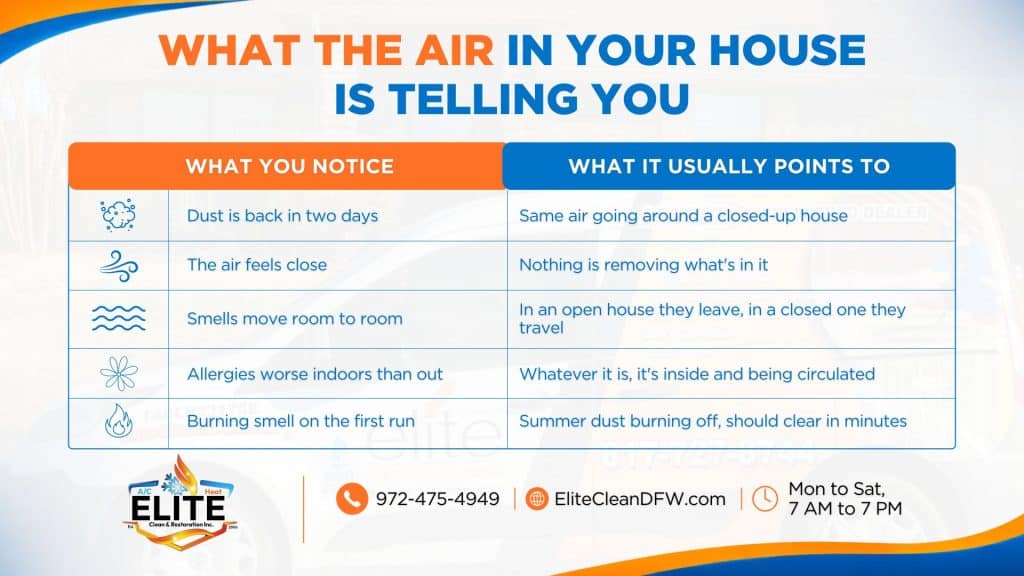
You wipe down the house on a Saturday, and by Monday there’s a film on the coffee table again. Nothing about your cleaning changed. What changed is that your system is now moving air through rooms that aren’t getting fresh air from anywhere, so the same dust gets picked up, carried, and dropped again.
This is the single most common reason somebody calls us about the air in their home, and it’s also one of the more satisfying ones to fix, because the difference shows up within a few days.
The air feels close, even when the temperature is right
The thermostat says what you set it to; nobody’s uncomfortable exactly, and yet a room feels heavy. People describe it as stuffy, or stale, or say the house feels like it needs a window opened.
That feeling comes from air that’s been going around the same path for weeks without anything removing what’s in it. The temperature is fine. The air just isn’t fresh, and no amount of adjusting the thermostat changes that.
Smells that won’t leave
Last night’s cooking is still there in the morning. The dog smells like the dog in every room instead of just where he sleeps. There’s a faint musty note somewhere, and you can’t pin down which room it’s coming from.
In an open house, smells leave on their own. In a closed-up house, they get picked up and redistributed. Everything that happens in one room ends up everywhere.
Allergies that act up indoors
Outdoor allergy season has passed, and somebody in the house is still going through tissues. They feel worse in the morning, better once they’ve been out of the house a while, and worse again in the evening.
When that pattern shows up, what’s bothering them is inside rather than outside, and it’s being moved around by the system. This one’s worth a call, because it tends to go on for months if nobody addresses it.
A burning smell the first time the heat runs
This one has a simple explanation. Dust settles on the heating side all summer, and the first time it heats up, that dust burns off. It should clear within a few minutes, and it isn’t a sign that something’s wrong.
If it doesn’t clear, or if you smell gas at any point, switch the system off and call us. That’s a different situation, and it’s worth treating as one.
Where It’s Coming From
Three things are usually in play, and they stack on top of each other.
A summer’s worth of dust on the heating side
The heating side of your system sits idle for months. Dust settles on it the whole time. Then it switches on, and the first thing it does is push all of that out into your rooms.
You can’t see it happening, which is why people tend to blame the weather or the kids or the dog. It’s none of those. It’s the system clearing its throat after a long rest.
The same air, going around again
A closed-up house recirculates. What’s in the air stays in the air, and it passes through your rooms again every time the system runs. Pet dander, cooking, whatever came in on shoes and coats, all of it keeps going around.
Opening a window helps for an hour, and then you close it because it’s cold. That’s the whole problem in one sentence.
What your filter catches, and what goes straight past it
Your filter is doing a job, and it’s worth changing on a sensible schedule. But a filter is a net, and the things that bother people most in a closed-up house are often smaller than the net.
That’s not a reason to feel bad about your filter. It’s the reason some homes need something beyond one, and it’s the honest answer to why a house can have a fresh filter in it and still feel stale.
The Questions We Get Asked on Nearly Every Visit
These come up at kitchen tables constantly, so here are the short answers.
How often should ducts be cleaned?
There’s no calendar answer, and anybody who gives you one without looking is guessing. It depends on how long it’s been, whether you have pets, whether the house has been through construction, and what’s actually in there. We look first and tell you where yours stands. Sometimes the answer is not yet.
Would a better filter fix it?
It helps, and it’s worth doing. What a filter can’t do is handle the things that are smaller than it, which is often exactly what’s bothering somebody. A better filter is a good move, and sometimes it’s enough. When it isn’t, that’s not a filter problem; it’s a sign your house needs something working on the air rather than just straining it.
Do houseplants make a difference?
They’re lovely, and they make a room feel better. For the volume of air moving through a whole house, the effect is small. Keep the plants because you like them, not as a plan.
Should I run the fan all the time?
Some people do this to keep air moving, and it does even things out across a floor plan. It also means the blower runs constantly, and if what’s in the air is the problem, you’re now circulating it more rather than less. It’s a reasonable thing to do once something is actually cleaning the air. On its own, it’s a mixed result.
Does an air freshener help?
It covers a smell rather than removing it, which is fine for an evening and frustrating as a long-term plan. If you’re reaching for one every day in the same room, that room is telling you something.
My house is only a few years old. Does any of this apply?
Newer homes are built tight, which is excellent for your energy bill and means less air exchange with the outside on its own. A new house can have cleaner ducts and still feel stuffier than an older one, and the fix is different. Age of the house isn’t the thing to go by.
Is this something I can sort out myself?
You can change a filter, and you should. Past that, the things that make a real difference need equipment and access that isn’t sitting in anybody’s garage, and the half measures sold for doing it yourself tend to move dust around rather than remove it. That’s our job, and it’s a single visit.
Starting With What’s Already in the System
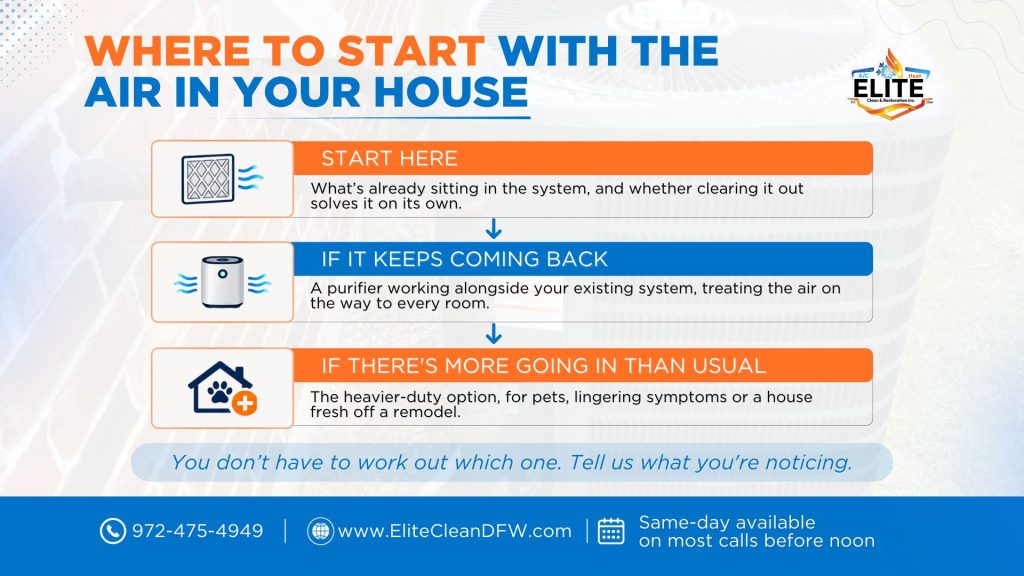
Before anybody talks to you about buying equipment, there’s a simpler question. What’s already sitting in your system, and would getting it out solve the problem on its own?
For a lot of homes, it does. If the ductwork has years of buildup in it, every bit of air that reaches your rooms passes through that first. Getting it out is often the single biggest difference you can make to how the air in your house feels, and it’s the first thing we look at.
We’ll tell you honestly whether yours needs it. If the system is clean and the problem is somewhere else, you’ll hear that, and you won’t be sold a cleaning you don’t need.
One of our customers put it better than we would: “The before and after photos are night and day.” That’s the part people don’t expect. You see what came out.
When Clean Ducts Aren’t the Whole Answer
Sometimes we clean a system, the house improves, and a few weeks later the homeowner calls to say it’s creeping back. That’s not a failed cleaning. It means something is putting things into the air faster than a clean system and a filter can take them out.
That’s the situation where equipment earns its place. Not as an upsell, and not for every house, but for the homes where the air keeps going back to where it started.
There are two kinds we install; they do different things, and the difference rarely gets explained properly. So here it is, without the chemistry.
What an Air Purifier Actually Does for You
An air purifier works with the system you already have. Instead of waiting for something to drift into a filter, it treats the air as it moves through, so it’s working on every room the system reaches rather than one corner of one room.
What that means in practice: the dust takes longer to come back. Cooking smells don’t follow you into the bedroom. The musty note you couldn’t place stops being there. If somebody in the house reacts to dander, the mornings get easier.
What it won’t do is make your house feel warmer, fix a room the air isn’t reaching, or substitute for getting a dirty system cleaned. Those are different problems with different answers, and we’d rather tell you that up front than have you spend money on the wrong thing.
If you want the technical detail on the system we fit, it’s on our air purification page. The thing worth knowing is simpler. It runs quietly in the background; it works on the whole house, and you notice it by what stops happening.
What an Air Scrubber Actually Does for You
An air scrubber is the heavier-duty option. Same basic idea, more capacity, aimed at homes where there’s more going into the air than usual.
Think of a house with several pets, or one where somebody’s symptoms are genuinely affecting their sleep, or a home that’s just been through a remodel and still smells like it. The ordinary answer isn’t quite keeping up. That’s where this one fits.
We install, service, and repair them, and we’ll tell you plainly whether your house is one that needs the step up. A lot aren’t, and we’ll say so.
Which One Fits Your House
Here’s the comparison nobody writes down straight, so we will.
If your house is generally fine and you just want the dust to stop coming back so fast, the smells to stop traveling, and the air to feel fresher, a purifier working alongside your existing system handles that. It’s the answer for the majority of the homes we visit.
If there’s more going into the air than a typical house, and you’ve already tried the straightforward things without getting where you want to be, that’s when the heavier option is worth the conversation.
And if the system itself is carrying years of buildup, neither one is the first move. Get that cleaned out, see where you land, and then decide. We’d rather do the cheaper thing first and have you call us back happy than sell you the bigger thing and have you wonder.
Will It Work With What I Already Have?
Almost always, and that’s the part people are surprised by. These work with the system that’s already in your house rather than replacing anything. Nothing comes out, no rooms get torn up, and your heating and cooling keep working the way it always has.
What we do need to look at is your particular setup, because the right fit depends on what you’ve got and how your house is laid out. That’s a short visit, not a project.
If something about your system means one option won’t work well, we’ll tell you before you commit to anything, not after.
What It’s Like to Live With One
People ask this, and nobody answers it, so you don’t really notice it. It runs when your system runs. There’s no separate thing to switch on, no box in the corner of the living room, no filter to remember on top of the one you already have.
Maintenance is light. There’s a part that gets replaced on a long interval, and we handle that when we’re out anyway.
The way you notice it is in the absence of things. You stop dusting as often. The house stops smelling like last night. Somebody who was going through tissues stops mentioning it. That’s the whole experience.
What Changes, and How Fast
People want to know what they’re actually buying, so here’s what the difference looks like from inside the house.
The first thing you notice is dusting. You go to wipe down the surfaces you always wipe down, and there’s less there than you expected. That shows up within the first week, and it’s the change homeowners mention back to us most.
Smells go next. Cooking stops following you upstairs. The room that always had a note to it stops having one. If there was a musty something you could never locate, it stops being there, and you realize a few days later that you haven’t thought about it.
The one that takes the longest is how the air feels, because it’s gradual and you adjust to it. People tend to notice that one in reverse, coming home from a trip and walking into a house that feels fine instead of closed.
And if somebody in the house was reacting to something, that’s the change families tell us about months later, usually in a review, usually about the mornings.
Where We’ll Tell You to Save Your Money
It’s worth being clear about where we’ll talk you out of something, because that’s as much a part of the visit as the work.
If your system is already clean, we’ll tell you, and we won’t clean it again for the sake of it. If a single room is the problem rather than the whole house, that’s an airflow question and no amount of air treatment fixes it, so we’ll look at the room instead. If your symptoms are seasonal and they’ll pass on their own, we’ll say so.
And if the straightforward answer solves your house, we’ll stop there rather than walking you up to the bigger one. A fair share of these visits end with a cleaning, a filter recommendation, and nothing else bought, and that suits us. People who got told the truth call back.
If You’ve Had It Done Before
Some homeowners tell us they had ducts cleaned a few years ago and didn’t notice much. That happens, and it’s usually one of two things.
Either the job wasn’t thorough, which you can tell by whether anybody showed you what came out, or the ducts weren’t the problem in the first place and cleaning them was never going to fix what was actually bothering you.
We’d rather find out which before you spend anything. If your system is genuinely clean, you’ll hear that, and we’ll go looking for the real answer instead of repeating something that already didn’t work.
What We Check While We’re There
A visit about the air in your house doesn’t stop at one thing, because the causes sit in a few different places. Here’s what gets a look.
- What’s actually in the ductwork, and whether clearing it out would solve the problem on its own
- Your filter, how it’s doing and whether the interval you’re on suits your house
- Airflow through the system, since a room that isn’t getting air has its own set of symptoms
- Whether every room is being reached, or whether one has been quietly left out
- The heating side, which is where a summer’s worth of dust has been sitting
- Drainage and anything that might be behind a musty smell
- Whether your house is a candidate for equipment, or whether the simpler answer covers it
You get all of it in writing, with a clear split between what wants attention now, what can wait, and what’s perfectly fine. That last group matters as much as the others, because knowing where you don’t need to spend is worth having. It’s also the sort of record people are glad to have a year or two later when something changes, and they want to know whether it’s new.
Homes Where This Matters More
Some houses feel the change more than others. If yours is one of these, a visit is worth more to you than it would be to a neighbor.
Pets
Dander goes everywhere a system reaches, which is every room, rather than only the one where the dog sleeps. Houses with two or more animals notice the difference from a visit faster than anybody, and it tends to be the thing a guest picks up on before the people who live there do, because you stop smelling your own house after a while.
Somebody in the house reacts to something
When symptoms are worse at home than away from home, and worse in the morning than the afternoon, that’s worth taking seriously. It’s also worth getting checked out properly by their doctor. What we can do is deal with the part that’s in the air of your house.
A recent remodel
Construction dust gets into a system and stays there, and it is finer than ordinary household dust, which is exactly why a standard filter struggles with it. Months later, a house that was renovated earlier in the year still doesn’t smell right, and nobody connects the two. If you’ve had work done in the last year or so, mention it when you call. It changes what we expect to find.
A new build
New construction comes with its own set of materials finishing off their smell, and new homes tend to be tightly sealed, which is great for your bill and less great for how the air feels. Builders also vary a lot in how clean a system is when it gets handed over, so a brand new house isn’t automatically a clean one.
A house nobody opens
If the windows in your home stay shut from one season to the next, there’s no reset. Everything that goes into the air stays in it, and the house gets gradually further from where it started without any single day where you notice the change. Those are the homes where the difference from a visit is most obvious, because nothing has been clearing things out on its own.
The Rooms That Tell You First
If you want to know whether this is your house, there are four rooms worth standing in for a minute.
The bedroom
It’s where somebody spends eight hours a night breathing the same air, and it’s usually the room where a reaction shows up first. If one person in your house wakes up congested and clears up by lunchtime, that’s the room talking.
The room with the dark furniture
Dust is invisible on most surfaces and obvious on a dark table or a piano lid. That room is doing you a favor, because it shows you what the rest of the house is doing quietly.
A room nobody uses
A guest room or a formal dining room that’s shut most of the time is where a musty note shows up earliest. Air still reaches it, nothing moves through it, and the result sits there until somebody opens the door.
The laundry room
It’s a small room doing a hot, humid job, and it’s often the one that smells first. If yours has a note to it, mention it when you call, because it points somewhere specific.
What It Does for the Rest of Your System
There’s a second argument for this that isn’t about how your house smells, and it’s the one that tends to land with whoever in the household is thinking about the bill.
A system that’s pulling air through a clean path doesn’t have to work as hard to move it. A system clogged with years of buildup is fighting its own ductwork every time it runs, which means longer run times for the same result.
You don’t need to know the engineering to know what that means. Equipment that works less hard lasts longer and costs less to run, and the money you spend keeping the air side clean tends to come back to you on the other end.
That’s a side benefit rather than the reason to do it. But it’s a real one, and it’s worth knowing when you’re weighing it up.
Before You Have People Over
There’s a practical reason to get this looked at ahead of the time of year when the house fills up.
A house with people in it produces more of everything. More cooking, more coats, more doors opening, more time with the heat running. If the air was already a little close with four people in the house, it’s noticeably close with twelve.
It’s also the thing guests notice without mentioning it. Nobody says anything about the air in your house. They just feel how it is.
Getting it sorted now means it’s done, off your list, and you’re not thinking about it when you’ve got actual things to think about.
It’s also a quieter week to get on our schedule than the ones ahead of it. One customer summed up how that part goes: “They were at our house when they said they would be here and did the work in a timely manner. They cleaned up after themselves, and everything looks very good.” Nobody wants a crew in the house the week before company arrives. A few weeks out, it’s a non-event.
What a Visit Looks Like
If you haven’t had us out before, here’s the whole thing. You call or book online, and a real person takes the details. Tell us what you’re noticing in your own words. You don’t need the right terminology, and you don’t need to have worked out the cause.
You get an arrival window you can plan around and a call before the technician sets off. An EPA-certified technician arrives in a marked vehicle and works from a written checklist rather than from memory.
Then they’ll walk you through what they found, in plain language, with the price before any work starts. If you’d rather think about it, think about it. Nobody is going to lean on you in your own kitchen, and if the honest answer is that nothing needs doing, you’ll hear that too.
One customer described the way that part goes: “He was very professional and took the time to explain the issue and preventative maintenance.” That’s what we’re going for.
How Long It Takes
People ask about time more than almost anything else, usually because they’re working out whether they need to take a morning off.
A look at the system and a straight answer about where you stand is short. Clearing out a system takes longer, because it’s thorough work and there’s no shortcut to doing it properly. Fitting equipment is a single visit rather than a project.
What makes a visit longer is a house with more than one system, a layout that puts the equipment somewhere awkward, or a cleaning that turns out to be bigger than it looked from the first room. You’ll hear which one you’re looking at once we’ve had eyes on it.
Either way, you get a real arrival window rather than a vague all-day wait.
Things That Aren’t Worth Worrying About
A fair share of what gets described to us on the phone turns out to be a house behaving the way houses behave, and it’s worth saying so plainly.
A burning smell the first time the heat runs is summer dust clearing off, and it should sort itself out in a few minutes. A system that’s louder on the first run of the season usually settles. Dust on the vents themselves is cosmetic and tells you very little about what’s further in.
And a house that feels different this time of year isn’t a house with a problem. Every closed-up house feels different. The question is only whether it bothers you enough to do something about it.
If you’re ever unsure which category you’re in, call and describe it. We’d much rather talk you through something harmless than have you worrying about it, and that call costs you nothing.
When to Call Us
Worth a call now
- The dust is back within a couple of days of cleaning
- Smells are moving from room to room instead of staying put
- Somebody’s symptoms are worse at home than anywhere else
- There’s a musty note you can’t trace to a room
- You’re hosting soon, and you’d like it dealt with first
Worth a call today
- A burning smell that doesn’t clear after a few minutes
- Any smell of gas, in which case switch the system off first
- Your system is running but the air coming out isn’t right
- You’re hearing something new from the equipment
For anything in the second list, same-day service is available on most calls placed before noon, and our team covers the whole metroplex.
Why Homeowners Call Us
We’re a family-owned company based in Rowlett, and we’ve been keeping homes across Dallas-Fort Worth comfortable since 2006. That’s nearly twenty years of neighbors calling us back and sending us to their friends, which is the only kind of growth we’ve ever really gone after.
If the honest answer is that everything’s in good shape, that’s what you’ll hear. That approach is how we’ve ended up with a 4.8 rating across more than 1300 reviews, and we’d rather protect that than squeeze anything extra out of one visit.
Here’s what one customer wrote after a recent visit: “Entire process was a breeze! Chris originally came out to my house to provide an estimate. He was very professional and took the time to explain the issue and preventative maintenance. The service team came out the next day ahead of schedule and exceeded my expectations. Both Ishmael and Bryan left the house spotless and updated me throughout the cleaning process. The before-and-after photos are night and day. The owner, Tony, spoke with me throughout the process and answered all of my questions. I would 10/10 recommend them; they are very competitive on price and know their business!
- Family-owned and based in Rowlett, looking after DFW homes since 2006
- 4.8 rating across more than 1,298 Google reviews
- EPA-certified, fully licensed technicians · Texas TACLB #TACLB023175E
- Lennox Preferred Dealer, Google Guaranteed, and an RGF licensed dealer for air duct purification
- Heating and cooling, air ducts, dryer vents, insulation, and air purification, all from one team
- Same-day service on most calls placed before noon, Monday through Saturday, 7 AM to 7 PM
- Upfront pricing before we start and a written summary after every visit
- 100% Satisfaction Guarantee on every job, financing available, and a Veteran’s Discount year-round
Final Thought
The air in your house is one of those things you only think about when it’s bothering you, and then you think about it constantly. Dust that won’t quit. A room that smells like something. Somebody sniffling through the evening.
None of it has to be permanent, and you don’t need to diagnose it first. Tell us what you’re noticing, and we’ll take it from there, starting with the simplest answer and only going further if your house actually needs it.
Call 972-475-4949 or book online at EliteCleanDFW.com · Same-day service on most calls before noon · Monday through Saturday, 7 AM to 7 PM · Looking after homes in Dallas, Fort Worth, Plano, Frisco, Rockwall, Richardson, Garland, Mesquite, Sachse, Sunnyvale, Grand Prairie, and Rowlett.


